Chatbots in Ride-hailing: Proven Wins and Pitfalls
What Are Ride-hailing Chatbots?
Ride-hailing chatbots are AI-powered assistants that help riders and drivers book rides, get trip updates, resolve fare or payment issues, and access support through in-app chat, websites, WhatsApp, or voice.
They connect with dispatch, maps, CRM, payment, and support systems to provide real-time information and complete common tasks. For broader support automation patterns, see AI Agents in Customer Support. For drivers, chatbots can also support onboarding, document queries, incentives, and safety-related workflows.
How Do Ride-hailing Chatbots Work?
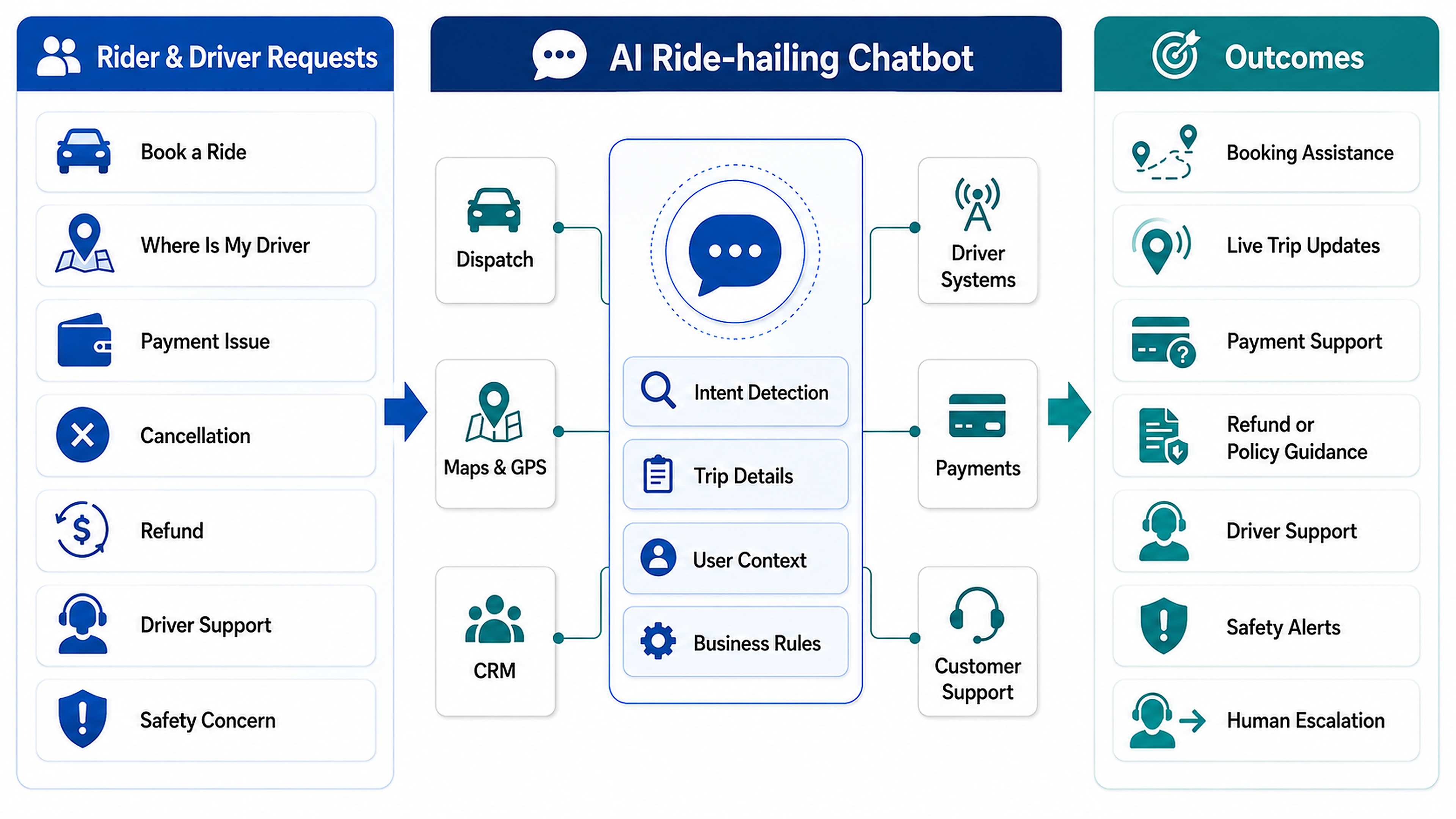
Ride-hailing chatbots work by identifying what the rider or driver needs, extracting relevant trip details, retrieving real-time data from connected systems, applying business rules, and returning or completing the appropriate action.
The typical workflow includes:
- Intent detection: Identifies requests such as booking a ride, checking driver location, or resolving a payment issue.
- Entity extraction: Captures details such as pickup point, destination, time, vehicle type, or promo code.
- Data retrieval: Connects with dispatch, maps, pricing, trip history, payment, and driver-status APIs.
- Policy checks: Applies refund rules, cancellation policies, safety workflows, and location-specific requirements.
- Personalized response: Uses trip context, profile, location, and language to provide a relevant answer or action.
- Human handoff: Escalates the conversation with context when confidence is low or human intervention is required.
What Are the Key Features of AI Chatbots for Ride-hailing?
Key features include omnichannel support, real-time integrations, multilingual conversations, proactive alerts, secure verification, human handoff, policy-aware responses, and performance analytics.
Essential features:
- Omnichannel support: In-app chat, WhatsApp, SMS, web, and voice IVR with a consistent brain. For voice-specific workflows, see Voice Agents in Customer Support.
- Real-time integrations: Dispatch, maps, payments, fraud checks, and driver telematics for live answers.
- Multilingual and locale-aware: Language, currency, and policy variations per city or country.
- Proactive messaging: Trip reminders, driver arrival, delay alerts, and safety check ins.
- Secure identity and verification: OTP, device fingerprint, and account binding to prevent abuse.
- Human handoff and case logging: Smooth escalation with full context into the agent console.
- Policy-aware reasoning: Automated refunds, cancellation fee waivers, and surge explanations based on rules.
- Analytics and training loop: Intent coverage, deflection, CSAT, and continuous improvement.
What Benefits Do AI Chatbots Bring to Ride-hailing?
AI chatbots for ride-hailing can improve service speed, operational consistency, scalability, rider and driver support, and access to self-service across the trip lifecycle.
Key benefits include:
- Faster support: Riders and drivers can get immediate help for common questions without waiting for an agent.
- Scalable service: Chatbots can handle repetitive support requests during peak periods, disruptions, and city events.
- Consistent policy guidance: Responses can follow configured rules for cancellations, refunds, surge pricing, and other common issues.
- Better rider and driver access: Support can be offered across in-app chat, web, WhatsApp, SMS, or voice.
- Reduced repetitive work: Human agents can spend more time on complex, sensitive, or safety-related cases.
- Operational visibility: Conversation data can reveal common issues, recurring intents, and areas where processes need improvement.
What Are the Practical Use Cases of Ride-hailing Chatbots?
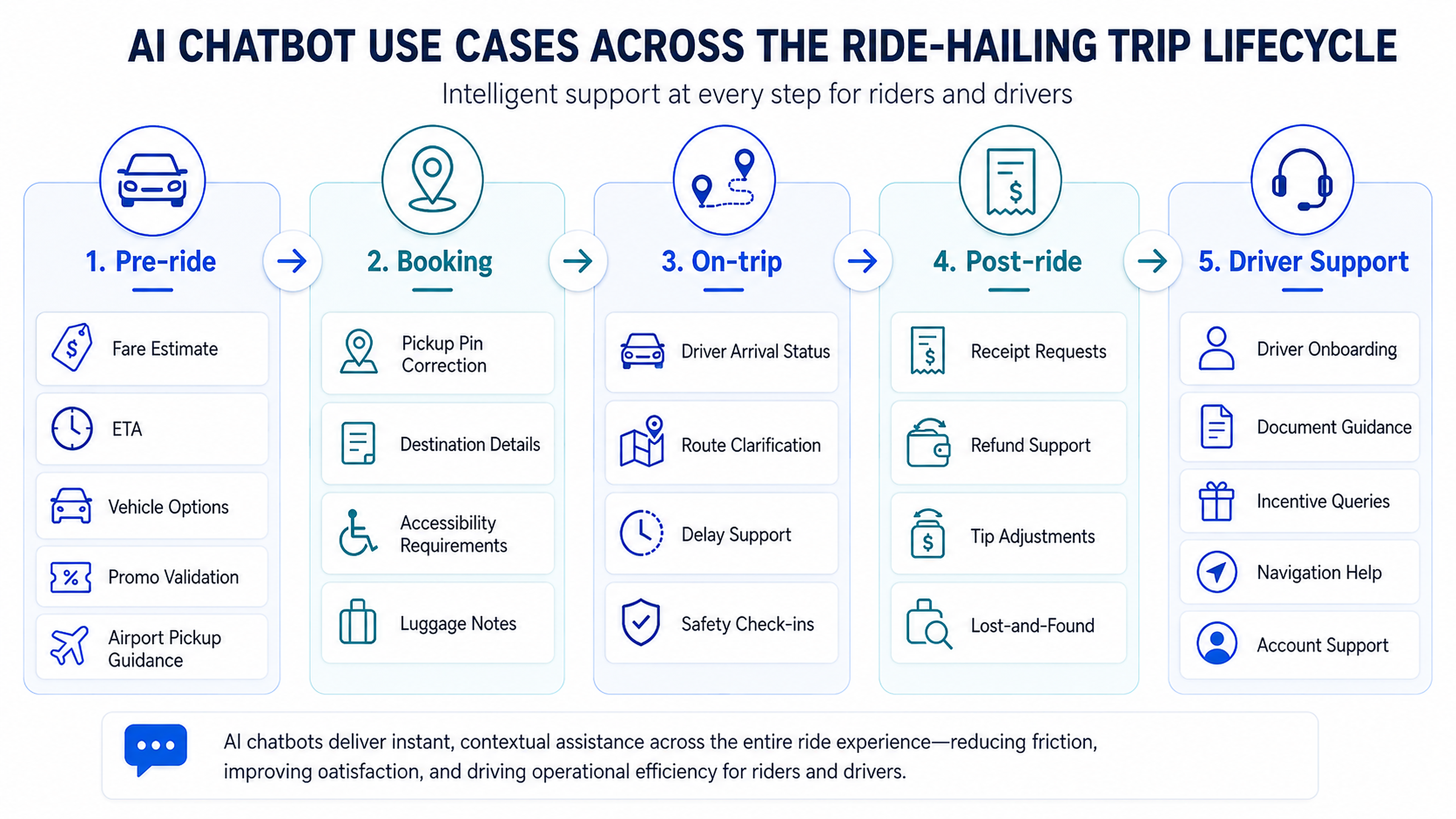
Common use cases include fare estimates, ride booking help, driver-location updates, payment support, refunds, lost-and-found intake, driver onboarding, safety workflows, and disruption alerts.
High-impact examples:
- Pre ride: Fare estimates, ETA, vehicle options, promo validation, and airport pickup instructions.
- Booking: Address disambiguation, location pin correction, and accessibility or luggage notes.
- On trip: Driver arrival status, route clarifications, safety check in, and contactless support.
- Post ride: Receipt requests, tip adjustments, lost and found intake, and simple refunds within rules.
- Driver side: Onboarding Q&A, document upload guidance, incentive tracking, and navigation help.
- Risk and trust: Account verification, unusual activity prompts, and payment method checks.
- Operations: Proactive broadcast for surge advisories, weather disruptions, or city policy changes.
What Ride-hailing Challenges Can AI Chatbots Solve?
Conversational AI for ride-hailing can address recurring operational problems such as support spikes, pickup-location confusion, policy questions, repetitive agent workloads, language gaps, and fragmented rider or driver communication.
They can help with:
- High-volume support spikes: Automated triage and self-service can absorb repetitive requests during peak hours, bad weather, and major city events.
- Pickup-location ambiguity: Conversational clarification and map-based validation can help riders correct pins or identify better meeting points.
- Policy confusion: Chatbots can explain cancellation fees, surge pricing, refunds, ratings, and other configured policies in plain language.
- Repetitive agent workloads: Routine requests can be handled automatically while complex or sensitive cases are escalated.
- Language gaps: Multilingual support can make common workflows more accessible across different rider and driver markets.
- Fragmented trip context: Connected systems can help the chatbot use trip, driver, payment, and account information in the same conversation.
How Are AI Chatbots Different from Traditional Ride-hailing Automation?
AI chatbots accept natural-language requests, maintain conversational context, ask clarifying questions, and connect with live systems, while traditional automation relies more heavily on fixed menus, rules, and predefined paths.
| Area | Traditional Automation | AI Chatbots |
|---|---|---|
| User input | Fixed menus, buttons, or forms | Natural-language text or voice |
| Conversation flow | Predetermined paths | Context-aware, flexible conversations |
| Clarification | Limited or rule-based | Can ask follow-up questions when information is missing |
| Trip context | Usually tied to predefined fields | Can combine trip, account, policy, and conversation context |
| Channels | Often designed separately by channel | Can support shared logic across app, web, WhatsApp, or voice |
| Improvement process | Manual script and rule updates | Conversation data and evaluations can identify where responses or workflows need refinement |
Traditional automation can still be appropriate for simple, deterministic tasks, while AI chatbots are more useful when users need flexible conversation, contextual assistance, or multi-system support.
How Can Ride-hailing Companies Implement AI Chatbots Effectively?
Effective implementation starts with clear goals, high-value intents, robust integrations, and a strong measurement framework. Pilots should target common, low-risk journeys and expand based on outcomes.
Practical steps:
- Define success metrics: Deflection rate, CSAT, FCR, booking conversion, and time to resolution.
- Map top intents: Use support data to identify the highest-volume, repetitive, and lower-risk intents to prioritize for automation.
- Integrate early: Connect dispatch, payments, CRM, and identity systems before launch.
- Design for handoff: Set thresholds for confidence and risk so humans intervene when needed.
- Train on policy and locales: Feed city-specific rules, fees, and languages into the bot.
- Test edge cases: Airports, multi stop rides, surge events, and connectivity drops.
- Launch incrementally: Start with in-app chat, then expand to WhatsApp, web, and voice.
- Build a feedback loop: Use transcripts and analytics to tune intents and content weekly.
How Do Chatbots Integrate with CRM, Dispatch, Payments, and Other Systems?
Chatbots integrate with CRM, ERP, dispatch, payments, and communications tools via secure APIs, webhooks, and event streams to deliver real-time actions and complete records. This turns conversations into operational outcomes.
Typical integrations:
- CRM and ticketing: Salesforce, Zendesk, or Freshdesk for case creation, tagging, and history. Digiqt's CRM 2.0 also shows how AI-powered chat, call summaries, task creation, and WhatsApp messaging can work around customer context.
- Dispatch and maps: Internal services for ETA, driver location, route deviations, and price estimates.
- Payments and risk: Payment gateways, chargeback tools, and fraud scoring for refunds and verifications.
- Driver platforms: DMS for onboarding, documents, background checks, and incentive tracking. Similar onboarding and information-capture patterns are covered in AI Agents in Client Intake.
- Communications: WhatsApp Business API, SMS, email, and voice IVR for omnichannel continuity.
- Analytics and CDP: Event pipelines for churn models, segmentation, and personalized messaging.
- ERP and finance: Revenue recognition, invoice reconciliation, and tax rules where applicable.
What Are Some Real-World Examples of Ride-hailing Chatbots?
Real-world ride-hailing companies are already using conversational AI for customer support, driver assistance, ride booking, and other trip-related workflows.
Uber: Customer Obsession Ticket Assistant
Uber developed its Customer Obsession Ticket Assistant (COTA) to help support agents identify issue types and recommended replies using machine learning and natural language processing.
Uber reported that the first version of COTA reduced English-language ticket resolution time by more than 10% while maintaining similar or higher customer satisfaction. Its later COTA v2 system used deep learning to improve ticket classification and reply recommendations.
Lyft: Customer Care AI Assistant
Lyft incorporated Claude through Amazon Bedrock into its customer-care AI assistant to respond to common support issues and route more complex cases to human specialists.
Lyft reported an 87% reduction in average customer-service resolution time after deployment, with the assistant resolving thousands of customer requests each day. These results are specific to Lyft's implementation and should not be treated as an industry benchmark.
Grab: Driver AI Assistant and AI Voice Assistant
Grab introduced a Driver AI Assistant that lets driver-partners speak or type questions and receive guidance on issues such as earnings, passenger situations, and common support needs.
Grab has also developed an AI Voice Assistant that helps visually impaired users book rides, receive driver-status updates, change payment methods, cancel rides, and interact with the service through voice commands.
Source: Grab Driver AI Assistant
Source: Grab AI Voice Assistant
Bolt: Ride Booking Through ChatGPT
In July 2026, Bolt announced a ride-hailing integration with ChatGPT, allowing users in supported markets to access Bolt ride-booking functionality through a conversational AI interface.
This example shows how ride-hailing chatbots are expanding beyond customer support into conversational ride discovery and booking.
These examples show that conversational AI in ride-hailing is already being used across support, driver assistance, accessibility, and booking workflows rather than as a single-purpose customer-service tool.
What Is the Future of AI Chatbots in Ride-hailing?
The future of AI chatbots in ride-hailing will be more multimodal, autonomous, policy-aware, and closely connected to rider and driver safety workflows.
Voice and multimodal support
Voice-first experiences can provide hands-free assistance for riders and drivers, while multimodal AI can combine text, map pins, pickup-point images, and other inputs to clarify location and trip context.
Agentic ride-support workflows
More advanced chatbots can perform multi-step tasks such as rebooking during disruptions, coordinating updates across systems, and handling eligible refunds tied to service rules. Faster on-device or edge inference may also improve response times in some workflows.
Policy-grounded AI responses
Retrieval-augmented generation can help chatbots answer using current company policies, local rules, and approved knowledge instead of relying only on static scripts.
AI-assisted safety and incident support
Safety-focused assistants can support proactive check-ins, incident triage, escalation to trust and safety teams, and other workflows that require rapid response and clear human oversight.
How Do Chatbots Improve Rider and Driver Experience?
Chatbots improve rider and driver experience by reducing uncertainty during time-sensitive moments, giving clearer answers, using trip context, and escalating smoothly when automated support is not enough.
Faster support during time-sensitive trips
Riders and drivers can get immediate assistance with pickup points, driver arrival, delays, route questions, or trip disruptions without waiting in a support queue.
Clearer answers about fares, delays, and refunds
Chatbots can explain surge pricing, cancellation charges, refund eligibility, receipts, and other policies in plain language using the current trip context.
Personalized rider and driver support
Connected profile, trip, location, language, and account data can help the chatbot provide more relevant answers instead of asking users to repeat information already available in the system.
Seamless human handoff when needed
When an issue is complex, sensitive, safety-related, or outside the chatbot's confidence threshold, the conversation can be escalated with the existing context preserved for the human agent.
What Mistakes Should Ride-hailing Companies Avoid When Deploying Chatbots?
Common mistakes include over-automating complex issues, launching without integrations, and ignoring driver needs. Avoiding these pitfalls can reduce user frustration and improve adoption.
Errors to watch for:
- No human handoff: Creates dead ends and frustration.
- Lack of real-time data: Bots guess instead of checking dispatch, causing wrong answers.
- Channel first rollout: Building WhatsApp flows without the core brain and integrations.
- Ignoring driver journeys: Driver queries often dominate volume and impact supply.
- One-size-fits-all language: Skipping multilingual support in diverse cities.
- Weak safety flows: Not prioritizing incident triage and escalation.
- No measurement plan: Lacking baselines for deflection, CSAT, and resolution time.
What Compliance and Security Measures Do Ride-hailing Chatbots Require?
Ride-hailing chatbots require privacy controls, secure payment handling, authentication, role-based access, encryption, audit logs, data-retention rules, and verified escalation processes.
Key measures:
- Privacy compliance: Determine which privacy laws apply to the service and market. Relevant frameworks may include the EU General Data Protection Regulation (GDPR) and the California Consumer Privacy Act (CCPA), as amended. Requirements can include transparency, data minimization, consumer rights, and controls around sensitive personal information.
- Payment security: Where payment account data is stored, processed, or transmitted, evaluate applicable PCI Data Security Standard (PCI DSS) requirements and use secure payment-tokenization practices where appropriate.
- Identity and access: Use strong authentication, role-based access control, and audit logs for administrative and chatbot actions.
- Data retention: Define retention rules for chat transcripts, trip context, and support records based on legal, operational, and privacy requirements.
- Platform security: Apply encryption in transit and at rest, secrets management, vulnerability testing, and broader cybersecurity risk controls. The NIST Cybersecurity Framework 2.0 provides a voluntary framework for managing cybersecurity risk.
- Safety workflows: Maintain verified escalation paths for incidents, emergency requests, trust-and-safety teams, and lawful requests from authorities.
- Vendor governance: Review third-party NLP, messaging, analytics, and AI providers for security, privacy, data-use, and contractual risks. The NIST AI Risk Management Framework can help organizations structure voluntary AI risk-management practices across design, deployment, and use.
How Should Ride-hailing Companies Measure Chatbot ROI?
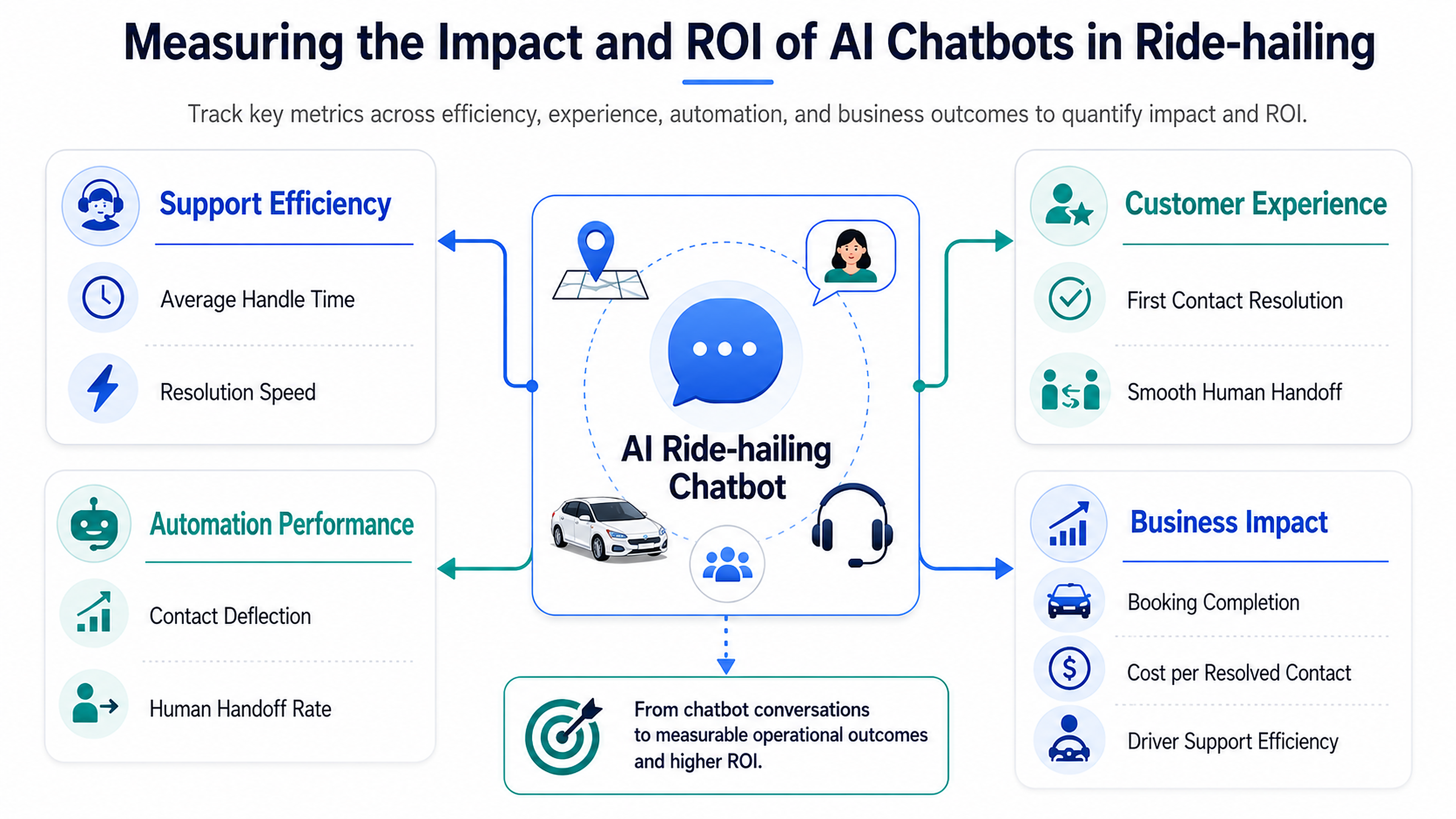
Ride-hailing companies should measure chatbot ROI by comparing support efficiency, customer outcomes, automation performance, and operating costs before and after deployment.
Key metrics include:
Contact deflection rate
Measures the share of support requests resolved through automated self-service without requiring a human agent.
Average Handle Time
Tracks whether chatbot-assisted workflows reduce the time human agents spend resolving escalated conversations.
First Contact Resolution
Measures how often a rider or driver issue is resolved in the first interaction without repeated follow-up.
Booking completion rate
Shows whether real-time chatbot assistance helps users complete ride bookings when they face pricing, pickup, payment, or location questions.
Human handoff rate
Tracks how often conversations require escalation and whether the chatbot is automating the right types of requests.
Driver support resolution time
Measures how quickly common driver issues such as documents, incentives, onboarding, or account questions are resolved.
Cost per resolved contact
Compares the total cost of automated and human-assisted support with the number of successfully resolved rider and driver requests.
Teams should establish a baseline before launch and track these metrics over time so chatbot performance is evaluated against measurable operational outcomes rather than assumed savings.
Conclusion
Ride-hailing chatbots can support faster, more consistent service when they combine natural-language understanding with live trip data, clear policies, and well-designed human handoffs. They are most useful for repetitive and time-sensitive requests, while safety, fraud, disputes, and other complex cases still require human oversight.
Ride-hailing companies evaluating conversational AI should start with high-volume, lower-risk journeys, connect the chatbot to the systems required for accurate answers, design clear human handoffs, and measure performance against defined service and operational KPIs.
Frequently Asked Questions
What are Chatbots in Ride-hailing?
Ride-hailing chatbots are AI-powered assistants that help riders and drivers book rides, get trip updates, resolve common issues, and access support through conversational channels.
How do Chatbots in Ride-hailing work?
Ride-hailing chatbots identify user intent, retrieve relevant trip or account data, apply business rules, and return an answer, action, or human escalation.
What are the benefits of using Chatbots in Ride-hailing?
Key benefits include faster support, scalable self-service, consistent policy guidance, reduced repetitive agent work, and easier access to rider and driver assistance.
Can ride-hailing chatbots book or modify rides?
Yes. When connected to booking and dispatch systems, they can help with ride requests, pickup or destination updates, vehicle options, and other supported trip changes.
Can chatbots handle refunds and cancellation disputes?
Chatbots can handle simple refund or cancellation requests when eligibility rules are clear and the required trip and payment data is available. Complex disputes should be escalated to a human.
When should a ride-hailing chatbot hand off to a human?
A chatbot should escalate when confidence is low, the issue is safety-related or sensitive, policy exceptions are required, fraud is suspected, or the user requests human assistance.
Can ride-hailing chatbots work through WhatsApp and voice?
Yes. The same conversational logic can support in-app chat, web, WhatsApp, SMS, or voice, although each channel may require different integrations and interaction design.
How should ride-hailing companies measure chatbot ROI?
Companies should track metrics such as contact deflection, Average Handle Time, First Contact Resolution, booking completion, human handoff rate, driver support resolution time, and cost per resolved contact.