19 AI Agents in Life Insurance Use Cases (2026)
- #AI Agents
- #Life Insurance AI
- #Insurtech
- #Underwriting Automation
- #Claims AI
- #Policy Personalization
- #Insurance Technology
- #Enterprise AI
How AI Agents Are Transforming Life Insurance Operations in 2026
Life insurance is one of the most relationship-driven segments in the entire insurance industry. Policies span decades, customer needs evolve with every life event, and the stakes of every claim involve deeply personal circumstances. Yet most life insurers still rely on manual workflows that create bottlenecks in underwriting, slow down claims settlement, and fail to engage policyholders proactively between purchase and maturity.
AI agents in life insurance are changing this reality. These autonomous software systems use machine learning, natural language processing, and predictive analytics to automate complex processes, personalize policyholder interactions, and deliver real-time decision support across the entire policy lifecycle.
For life insurance carriers evaluating digital transformation, the question is no longer whether AI agents can handle the complexity of life insurance operations. It is how quickly they can deploy these systems before competitors capture the market advantage.

According to McKinsey's 2025 Insurance Report, AI adoption across life insurance is expected to generate $50 billion in annual value globally by 2026. Deloitte's 2025 Global Insurance Outlook found that 78% of life insurance executives plan to deploy AI agents across underwriting and customer engagement within the next two years. Accenture reports that life insurers using AI-powered automation have achieved 40% faster policy issuance and 30% lower servicing costs compared to those relying on traditional workflows.
The competitive gap between AI-enabled life insurers and those still dependent on manual processes is widening every quarter. Carriers that act now will define the next era of life insurance. Those that delay risk irrelevance.
Why Do Life Insurance Carriers Lose Revenue Without AI Agents?
Life insurers without AI agents face compounding inefficiencies across underwriting, policy servicing, and claims that directly erode profitability and policyholder trust.
1. Slow Underwriting Drives Applicant Drop-Off
Traditional life insurance underwriting involves manual collection of health records, financial data, and risk assessments. This process typically takes 4 to 6 weeks, during which 30% of applicants abandon their applications. Every lost applicant represents thousands in lifetime premium revenue that flows to faster competitors.
2. Policy Lapses Erode Long-Term Revenue
Life insurance carriers lose an estimated 8% to 12% of their in-force premium annually due to policy lapses. Without proactive monitoring and timely intervention, policyholders miss payments, forget renewal dates, or simply disengage. Manual reminder systems are inconsistent and cannot scale across millions of policies. Carriers leveraging AI agents in insurance have demonstrated how automated engagement dramatically reduces churn.
3. Manual Claims Processing Damages Brand Trust
Death claims and maturity settlements are the most emotionally significant moments in a life insurance relationship. When these processes take weeks due to manual verification, document collection, and multi-level approvals, the damage to brand reputation extends far beyond the individual claim. Family members share negative experiences widely, affecting future acquisition.
4. Compliance Gaps Create Regulatory Exposure
Life insurance regulation evolves constantly, and carriers managing compliance manually cannot keep pace. Missed regulatory updates lead to non-compliant disclosures, incorrect policy terms, and audit failures that result in fines ranging from $500,000 to $5M annually. Organizations implementing AI agents in compliance have significantly reduced this exposure.
| Challenge Without AI | Annual Impact | AI Agent Solution |
|---|---|---|
| Slow underwriting | 30% applicant drop-off | Real-time risk scoring in hours |
| Policy lapses | 8-12% premium revenue loss | Proactive engagement and reminders |
| Manual claims processing | 3-6 week settlement delays | Auto-verification and fast-track approval |
| Compliance gaps | $500K-$5M in regulatory fines | Continuous monitoring and auto-flagging |
| Generic policy recommendations | Low cross-sell conversion | Personalized life-stage suggestions |
Stop losing premium revenue and policyholder trust to manual life insurance operations. Digiqt builds AI agent solutions that eliminate these costly inefficiencies.
Visit Digiqt to learn how we help life insurance carriers deploy production-ready AI agents.
What Are AI Agents and How Do They Work in Life Insurance?
AI agents in life insurance are autonomous software systems that use machine learning, natural language processing, and intelligent automation to perform complex tasks across the policy lifecycle without continuous human oversight. They analyze data, learn from interactions, make decisions, and execute actions across underwriting, policy servicing, claims, and customer engagement.
Unlike basic chatbots or rule-based automation, AI agents in life insurance adapt and improve over time. They process context from decades of policyholder data, health records, financial behavior, and regulatory requirements to deliver intelligent, personalized responses. For a foundational overview of how these systems work, explore our detailed guide on AI agents in insurance.
1. How AI Agents Differ from Traditional Life Insurance Software
Traditional life insurance platforms follow static rules. If a policyholder meets criteria X, trigger action Y. AI agents go further by evaluating hundreds of variables simultaneously, weighing probabilities across health, financial, and behavioral data, and making nuanced decisions that account for each policyholder's unique context, history, and life stage.
2. Core Technologies Powering Life Insurance AI Agents
AI agents in life insurance combine multiple technologies including large language models for document understanding and policyholder communication, computer vision for medical record and KYC document verification, predictive analytics for mortality risk scoring and lapse prediction, and reinforcement learning for continuous optimization of engagement strategies. These technologies work together to create agents capable of managing the full policy lifecycle autonomously.
What Are the Top 19 Use Cases of AI Agents in Life Insurance?
AI agents in life insurance are transforming every major function across the policy lifecycle, from initial application through maturity settlement. Here are the 19 most impactful use cases delivering measurable ROI for life insurers today.
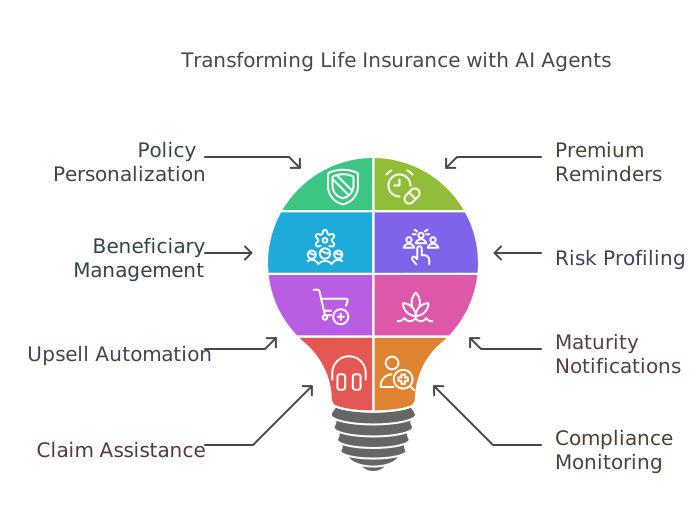
1. Policy Personalization Based on Life Stage
AI agents in life insurance analyze a customer's current life stage, financial status, and future goals to recommend the most suitable policies. A newly married individual may need a term plan with family protection, while someone nearing retirement benefits from a pension-oriented plan. These AI agents evaluate income, dependents, health condition, and existing coverage to deliver tailored suggestions rather than generic offerings. Carriers exploring AI agents in annuities are using similar personalization for retirement-focused products.
2. Proactive Premium Reminders and Lapse Prevention
One of the largest revenue leaks in life insurance is policy lapse due to missed payments. AI agents proactively monitor policy timelines and send timely reminders through email, SMS, WhatsApp, or app notifications. They interact with policyholders to offer flexible payment options or escalate to a human advisor when they detect potential churn risk. This automation significantly reduces lapse rates and improves customer retention across the entire book of business.
3. Beneficiary and Nominee Management
Life insurance policies often span decades during which personal circumstances change substantially. AI agents periodically prompt policyholders to review and update nominee details, reducing complications during claim settlement. They verify nominee data against KYC requirements, ensuring smoother processing when the policy matures or a claim is initiated.
4. Risk Profiling and Underwriting Assistance
Underwriting is the most critical step in life insurance. AI agents streamline this by collecting relevant data from digital health records, wearable devices, lifestyle habits, and financial behavior. They help underwriters build accurate risk profiles and determine appropriate premiums. Some AI agents perform pre-underwriting checks in real time during the application process, reducing turnaround from weeks to hours.
5. Rider Suggestions and Upsell Automation
Instead of offering blanket upsells, AI agents analyze gaps in a policyholder's existing coverage and recommend relevant riders such as critical illness, accidental death, or premium waiver options. These recommendations are data-driven and personalized, increasing the likelihood of acceptance while improving protection for the customer and driving incremental revenue for the insurer.
6. Policy Maturity Notifications and Conversion Support
As term plans approach maturity, AI agents automatically notify customers about their options, whether to convert to a whole life plan, reinvest in another product, or withdraw funds. These agents offer simulations of how each choice affects long-term benefits, enabling smarter decisions and reducing policy churn at the maturity stage. Life insurers managing pension plan portfolios are using the same approach for retirement product transitions.
7. Death Claim Preparation and Family Assistance
AI agents ease the burden on beneficiaries by initiating the claims process, guiding them through required documentation, and providing real-time support. If nominee details are pre-verified, the agent automatically pulls up necessary data and auto-fills forms. This ensures a more compassionate and efficient experience during an emotionally difficult time.
8. Regulatory Compliance Monitoring
Life insurance is heavily regulated, with frequent updates from regulatory bodies. AI agents continuously monitor regulatory changes and ensure all processes from customer onboarding to claim settlement remain compliant. They flag non-compliant policies or transactions, helping insurers avoid penalties and maintain audit readiness. Carriers investing in AI agents in compliance are seeing significant reductions in regulatory exposure.
9. Cross-Channel Consistency for Long-Term Customers
Life insurance involves long-term engagement often spanning decades. AI agents ensure that regardless of how or where a customer interacts, whether through a chatbot, call center, mobile app, or WhatsApp, they receive consistent, context-aware support. This builds trust over time and eliminates the frustration of repeating information across channels.
10. Financial Planning Assistance
Beyond insurance, AI agents act as virtual financial advisors. They analyze a customer's financial data and life goals to suggest how life insurance fits into their broader portfolio, whether for retirement planning, child education, or wealth transfer. This holistic guidance strengthens the insurer-customer relationship and positions the brand as a trusted advisor.
11. Dynamic Risk Monitoring via Health and Lifestyle Integration
AI agents connect with wearables and health apps to gather real-time data on a policyholder's daily activities, sleep patterns, heart rate, and fitness goals. This continuous data stream allows insurers to dynamically assess risk rather than relying on one-time health checks. A healthy lifestyle over time could lead to loyalty rewards, reduced premiums, or health-focused incentives that improve retention.
12. Legacy and Estate Planning Support
For high-net-worth individuals, life insurance is a key element of estate and legacy planning. AI agents guide policyholders on how to structure policies for wealth transfer, minimize tax liabilities, and integrate policies with trusts or wills. These agents prompt periodic reviews based on regulatory changes or major life events, ensuring legacy plans remain aligned with long-term wishes.
13. Customer Sentiment Analysis
AI agents equipped with natural language processing analyze tone, emotion, and content from customer communications including emails, chat transcripts, and call logs. By understanding customer sentiment in real time, insurers identify dissatisfaction, confusion, or disengagement early. This enables proactive intervention such as routing the customer to a human advisor or initiating retention offers.
14. Pre-Underwriting Health Questionnaire Automation
Before formal underwriting, AI agents engage applicants with intelligent health questionnaires. Unlike static forms, these are conversational and adaptive, adjusting based on responses to collect accurate data efficiently. This speeds up the underwriting process and ensures the insurer has high-quality inputs from the start, resulting in faster policy issuance.
15. Policy Consolidation and Optimization
Many customers hold multiple life insurance policies across different providers, often leading to overlaps or inefficiencies. AI agents consolidate this information, analyze overall coverage, and suggest adjustments. They identify gaps in protection or opportunities to reduce premium outflow while maintaining sufficient coverage, making them valuable financial companions for long-term policyholders.
16. Customer Lifecycle Journey Mapping
AI agents create and manage a detailed lifecycle map of every customer, tracking major milestones such as onboarding, anniversaries, premium payments, family additions, and nearing retirement. At each stage, the agent triggers relevant and personalized messages, offers, or recommendations, ensuring customers feel supported throughout their policy term.
17. Lead Scoring for High Lifetime Value Customers
Not all leads carry the same potential, especially in life insurance where long-term retention drives profitability. AI agents assess lead quality based on demographic data, behavioral signals, financial activity, and digital engagement. By assigning a lifetime value score, sales teams prioritize high-potential leads and optimize resource allocation for better conversion rates.
18. Automated Surrender Value Calculation and Advisory
When a customer considers surrendering their policy, AI agents instantly calculate the current surrender value, explain its implications, and offer alternative solutions such as taking a loan against the policy or reducing the premium. By providing financial clarity and suggesting value-preserving alternatives, these agents reduce unnecessary policy cancellations.
19. Multi-Generational Policy Engagement
Life insurance often involves long-term family planning. AI agents detect when policyholders' children reach a certain age and trigger engagement, recommending term plans, guiding financial planning, or assisting with nominee transitions. This creates opportunities for cross-generational loyalty and turns the insurer into a lifelong financial partner for the family.
What Are the Key Benefits of AI Agents for Life Insurance Carriers?
AI agents in life insurance deliver measurable operational and business benefits that compound over time. Life insurers adopting AI agents are seeing improvements across customer experience, cost structure, risk management, and revenue growth.
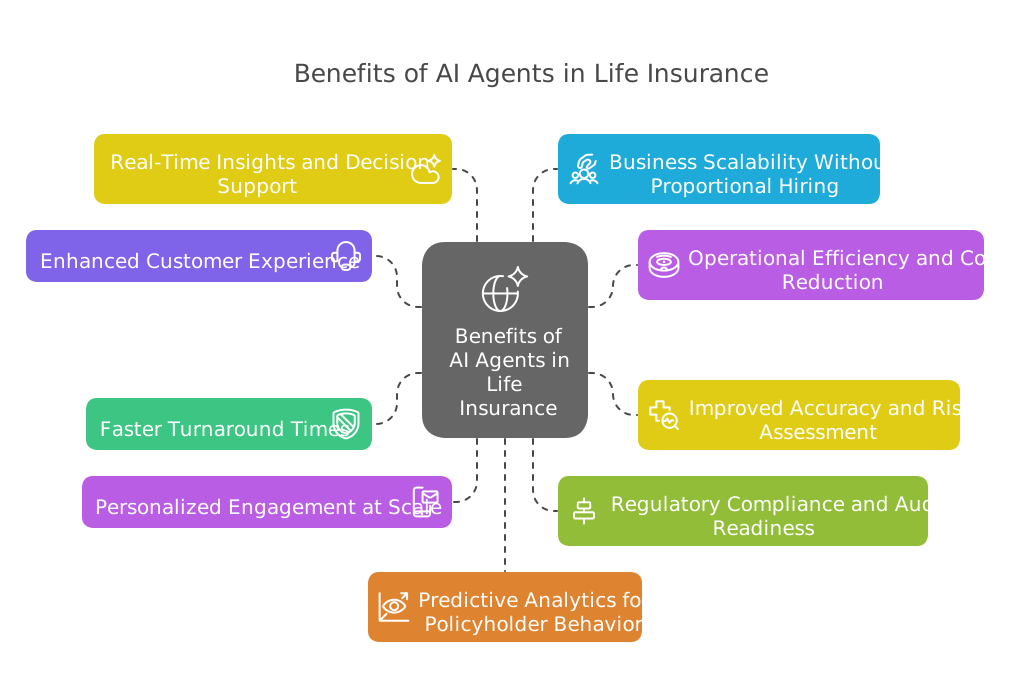
1. Enhanced Customer Experience at Scale
AI agents offer instant, personalized support across WhatsApp, websites, mobile apps, and voice platforms. Customers no longer wait in long queues or deal with limited call center hours. Whether understanding policy benefits, completing documentation, or resolving queries, AI agents deliver quick, helpful, and consistent interactions that build long-term loyalty.
| Benefit | Impact Without AI | Impact With AI Agents |
|---|---|---|
| Response time | 24-72 hours | Instant (under 30 seconds) |
| Channel availability | Business hours only | 24/7 across all channels |
| Personalization | Generic responses | Life-stage tailored interactions |
| Policy lapse rate | 8-12% annually | 3-5% annually |
| Underwriting turnaround | 4-6 weeks | 24-48 hours |
| Claims settlement | 3-6 weeks | 3-7 days |
2. Operational Efficiency and Cost Reduction
Life insurance companies manage massive volumes of repetitive tasks from policy servicing to document verification. AI agents handle these tasks autonomously, reducing dependency on large manual teams. This cuts operational costs by 25% to 35% while improving speed and accuracy, allowing insurers to allocate human resources to advisory services, relationship building, and product innovation.
3. Improved Accuracy in Risk Assessment
AI agents excel at analyzing large datasets with precision, including health records, lifestyle inputs, and financial data, to assist in risk profiling and underwriting. Their ability to process complex variables without fatigue reduces manual errors, leading to more accurate premium calculations and fairer policy decisions that enhance both customer trust and insurer profitability.
4. Faster Turnaround Across the Policy Lifecycle
From onboarding to claims servicing, AI agents drastically reduce the time required to complete life insurance processes. They instantly verify documents, auto-fill forms, and make real-time decisions based on pre-trained logic and AI models. This acceleration enhances the customer experience and increases operational throughput, especially during high-volume enrollment periods.
5. Personalized Engagement Without Manual Effort
AI agents analyze a customer's history, preferences, life stage, and behavior to deliver tailored messages, offers, and policy suggestions. Whether recommending relevant riders, reminding customers about maturity benefits, or offering a new policy aligned with recent life changes, this personalization builds trust and relevance at scale without requiring human intervention for each case.
6. Continuous Regulatory Compliance
The life insurance sector is subject to strict regulatory oversight. AI agents continuously track regulatory updates, auto-flag compliance gaps, and ensure documentation, disclosures, and communication align with guidelines. They maintain detailed logs and audit trails, making it easier for insurers to stay compliant and avoid legal risks.
7. Real-Time Insights for Strategic Decision-Making
AI agents collect and process vast amounts of customer interaction data that becomes actionable insights. Insurers use these insights to improve underwriting models, refine products, identify upsell opportunities, and enhance marketing campaigns. Real-time analytics empower decision-makers to act quickly and adapt to changing customer needs.
8. Business Scalability Without Proportional Hiring
Traditional scaling in life insurance requires hiring and training large teams. With AI agents, insurers handle increased policy volumes, customer queries, and servicing needs without adding headcount. This makes business expansion more cost-effective and enables firms to serve larger customer bases without compromising quality or responsiveness.
9. Predictive Analytics for Policyholder Behavior
AI agents use predictive modeling to anticipate customer behavior such as potential lapses, upgrade interest, or churn risk. By identifying these signals early, insurers take proactive steps to retain customers, improve satisfaction, and boost lifetime value. These insights create more intelligent and responsive customer journeys that compound retention over time.
What Are the Biggest Challenges of Deploying AI Agents in Life Insurance?
While AI agents are transforming many insurance segments, their adoption in life insurance presents unique challenges due to the deeply personal, long-term, and emotionally driven nature of these products. Life insurers must navigate these challenges strategically to achieve successful deployment.
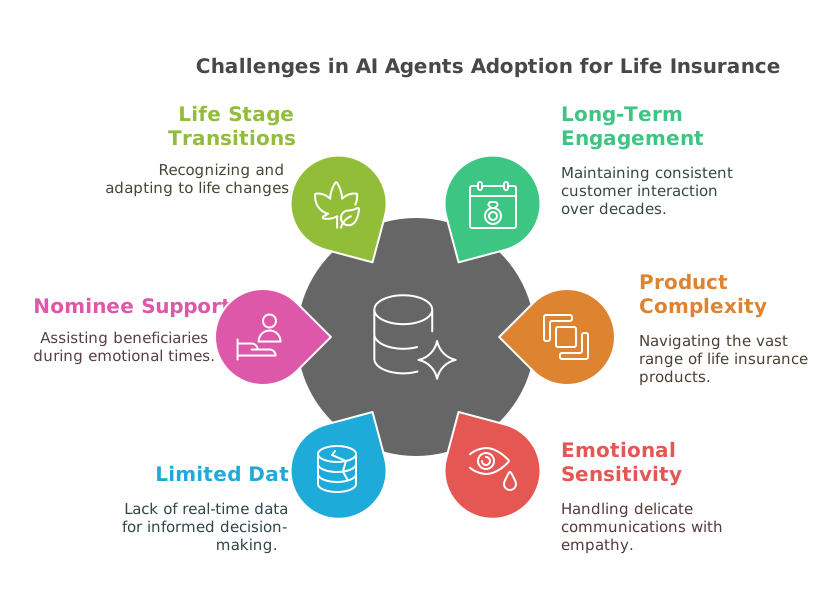
1. Maintaining Consistency Over Decades-Long Relationships
Life insurance requires sustained communication, education, and policy servicing over 20 to 40 years. AI agents must maintain context about a customer's journey, preferences, and life changes throughout this entire period. Without ongoing training and data updates, AI agents risk offering outdated advice or losing relevance, directly affecting customer trust.
2. Navigating Complex Product Suitability
From term plans and whole life policies to ULIPs, annuities, and riders, the range of life insurance products is vast and highly nuanced. AI agents must understand deep customer contexts like income stability, future liabilities, risk appetite, and family structure. Recommending a mismatched product leads to dissatisfaction and regulatory scrutiny. Carriers exploring AI agents in annuities face similar complexity in product matching.
3. Handling Sensitive Communication Around Death and Illness
Communication around death, terminal illness, and financial protection for beneficiaries is one of the most emotionally delicate aspects of life insurance. AI agents must handle such conversations with appropriate tone and sensitivity. Generic responses or tone mismatches during moments of grief can damage the insurer's brand image significantly.
4. Limited Real-Time Data After Onboarding
Unlike motor or health insurance where telematics and wearables provide continuous data streams, life insurance often lacks real-time data inputs after the initial onboarding. Without fresh insights into a policyholder's health changes or financial status, AI agents are limited in their ability to offer updated recommendations or trigger timely engagement.
5. Nominee Communication and Claims Support Complexity
Life insurance claims often involve nominees who are unfamiliar with the policy or claims process. AI agents must explain documentation requirements, guide them through settlement procedures, and provide support during emotional distress. Crafting AI systems that deliver both clarity and empathy in nominee interactions is uniquely challenging. Companies building AI agents for insurance claims are investing heavily in this capability.
6. Detecting Life Stage Transitions Automatically
Life insurance needs evolve with marriage, childbirth, career changes, or retirement. Unless a customer explicitly updates their profile, AI agents may not detect these transitions in real time. This results in missed opportunities for policy reviews, upselling, or adding riders at critical engagement moments.
7. Regulatory Complexity Around Surrenders, Maturities, and Loans
Life insurance involves intricate policy features including surrender value, loan against policy, partial withdrawals, and maturity benefits. Each has varying rules depending on product type, term length, and regulatory guidelines. AI agents must navigate these complexities accurately and explain them clearly to customers. Miscommunication about surrender penalties or loan terms could result in financial confusion or legal exposure.
8. Trust Deficit in Automated Financial Advisory
Life insurance is both a protection tool and a financial planning instrument. When customers think about building wealth, planning for retirement, or protecting their family legacy, they often seek personalized human advice. Trusting an AI agent to guide these deeply personal decisions remains a hurdle that insurers must address through transparency, explainability, and hybrid human-AI workflows.
How Do AI Agents Compare to Human Agents in Life Insurance?
AI agents and human agents each bring distinct strengths to life insurance operations. The most effective life insurers combine both capabilities rather than replacing one with the other.
AI agents deliver unmatched speed, accuracy, and availability. They serve thousands of customers simultaneously, compare policies instantly, calculate premiums in real time, and provide 24/7 support without fatigue. For routine tasks like premium reminders, document verification, and policy status inquiries, AI agents are significantly more efficient than human counterparts.
Human agents, however, bring emotional intelligence, relationship-building skills, and the ability to navigate complex personal conversations that AI cannot fully replicate. When a family faces a death claim, when a customer needs guidance through a major life transition, or when trust needs to be established for a high-value policy decision, human advisors remain essential.
| Capability | AI Agents | Human Agents |
|---|---|---|
| Availability | 24/7 across all channels | Business hours, limited capacity |
| Processing speed | Instant (thousands concurrent) | One customer at a time |
| Consistency | Uniform responses every time | Varies by individual |
| Emotional intelligence | Limited, improving | Strong empathy and nuance |
| Complex advisory | Data-driven recommendations | Relationship-based guidance |
| Cost per interaction | $0.10-$0.50 | $15-$45 |
| Scalability | Unlimited | Requires proportional hiring |
The future of life insurance is a hybrid model where AI agents handle the heavy lifting of data processing, routine servicing, and proactive engagement, while human advisors step in for high-stakes decisions and emotionally sensitive moments. Life insurers managing pension plan portfolios are already demonstrating the effectiveness of this combined approach.
How Does Digiqt Deliver Results?
Digiqt follows a proven delivery methodology to ensure measurable outcomes for every engagement.
1. Discovery and Requirements
Digiqt starts with a detailed assessment of your current operations, technology stack, and business objectives. This phase identifies the highest-impact opportunities and establishes baseline KPIs for measuring success.
2. Solution Design
Based on the discovery findings, Digiqt architects a solution tailored to your specific workflows and integration requirements. Every design decision is documented and reviewed with your team before development begins.
3. Iterative Build and Testing
Digiqt builds in focused sprints, delivering working functionality every two weeks. Each sprint includes rigorous testing, stakeholder review, and refinement based on real feedback from your team.
4. Deployment and Ongoing Optimization
After thorough QA and UAT, Digiqt deploys the solution with monitoring dashboards and performance tracking. The team continues optimizing based on production data and evolving business requirements.
Ready to discuss your requirements?
Why Should Life Insurance Carriers Choose Digiqt for AI Agent Development?
Digiqt specializes in building production-ready AI agent systems for life insurance carriers, group insurers, and distribution partners. Unlike generic AI vendors offering one-size-fits-all solutions, Digiqt delivers life insurance-specific AI architectures designed for the regulatory, operational, and data complexity that life insurers face daily.
1. Life Insurance-Native AI Models
Digiqt's AI agents are trained on life insurance-specific datasets and workflows. Every model understands the nuances of mortality risk assessment, policy lifecycle management, regulatory compliance, and sensitive beneficiary communication. This domain expertise translates to faster deployment, higher accuracy, and fewer false positives compared to generic AI platforms.
2. Compliance-First Architecture
Every AI agent Digiqt builds includes explainability layers, audit trails, and data governance protocols that meet IRDAI, GDPR, HIPAA, and state insurance department requirements. Life insurers never have to choose between AI efficiency and regulatory compliance. Carriers focused on AI-driven reinsurance benefit from the same compliance-first approach across treaty and facultative workflows.
3. Proven Life Insurance Deployments
Digiqt has delivered AI agent solutions for term life carriers, whole life insurers, ULIPs, and group insurance providers. Each deployment follows a structured pilot-to-scale methodology that minimizes risk and maximizes measurable ROI within the first quarter.
4. End-to-End Partnership
From initial use case identification through production deployment and ongoing model optimization, Digiqt provides a complete partnership. Life insurers get a dedicated team of AI engineers, insurance domain experts, and integration specialists who understand both the technology and the unique complexities of life insurance operations.
Will Life Insurers Who Delay AI Agent Adoption Remain Competitive in 2027?
The competitive window for AI adoption in life insurance is closing rapidly. Carriers that deploy AI agents today are building compounding advantages in underwriting speed, policyholder retention, claims efficiency, and compliance that late adopters will find nearly impossible to overcome.
Every month of delay means more applicants abandoning slow underwriting processes, more policies lapsing due to inconsistent engagement, more claims settlements damaging brand trust through weeks of unnecessary delays, and more compliance gaps creating regulatory exposure.
The life insurance carriers that will lead the industry through 2026 and beyond are the ones making AI agent deployment decisions right now. The technology is proven. The ROI is documented. The only remaining variable is execution speed.
Life insurers that act today will capture policyholders, reduce costs, and build the operational infrastructure that defines market leadership for the next decade. Those that wait will spend years trying to close a gap that grows wider every quarter.
Do not let manual processes define the future of your life insurance operations. Talk to Digiqt today about deploying AI agents that deliver measurable results in 90 days.
Visit Digiqt to start your life insurance AI agent journey.
Frequently Asked Questions
What are AI agents in life insurance?
AI agents are autonomous software systems that automate underwriting, claims, policy servicing, and customer engagement for life insurers using ML and NLP.
How do AI agents reduce life insurance policy lapse rates?
AI agents send proactive premium reminders, detect churn signals, and offer flexible payment options to retain policyholders before lapse occurs.
Can AI agents handle life insurance death claims sensitively?
Yes, AI agents guide beneficiaries through documentation, auto-fill verified nominee data, and escalate to human advisors for emotional support.
What ROI do life insurers achieve with AI agents?
Life insurers typically see 40% faster underwriting, 55% fewer policy lapses, and 30% reduction in operational costs with AI agents.
How do AI agents improve life insurance underwriting accuracy?
AI agents analyze health records, wearable data, and financial behavior in real time to build precise risk profiles for life insurance applicants.
Are AI agents in life insurance compliant with IRDAI regulations?
Yes, properly configured AI agents continuously monitor regulatory updates and maintain audit trails to ensure full IRDAI and GDPR compliance.
How long does it take to deploy AI agents for life insurance?
A pilot deployment typically takes 8 to 12 weeks, with full production rollout across core functions within 6 months.
Why should life insurers choose Digiqt for AI agent development?
Digiqt delivers insurance-native AI agents with life insurance-specific models, compliance frameworks, and proven carrier deployment methodology.