AI Agents in K-12 Education: 10 Use Cases (2026)
How AI Agents Support Students, Teachers, Families, and School Operations
School districts manage thousands of recurring interactions across classrooms, family communication, enrollment, attendance, IT support, transportation, and administration. Many of these workflows require staff to search multiple systems, repeat the same information, or manually route requests.
AI agents can help by combining approved school content, system integrations, workflow rules, and human escalation. They can answer routine questions, assist staff, guide users through processes, and trigger permitted actions without replacing educators or administrators in high-impact decisions.
The goal is not to automate every school interaction. It is to identify repetitive, measurable workflows where AI can reduce friction while preserving student privacy, safety, and human accountability.
What Are AI Agents in K-12 Education?
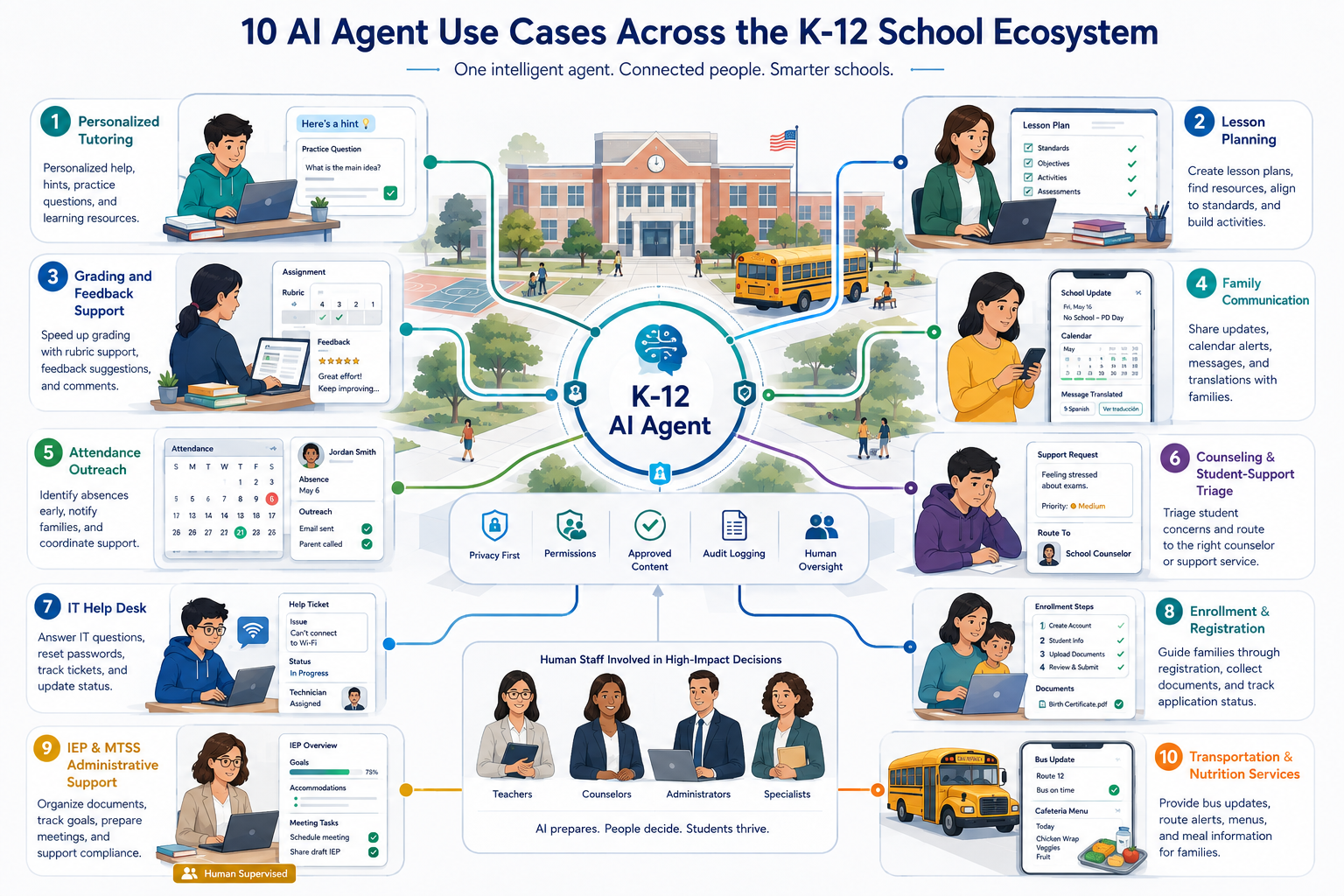
AI agents in K-12 education are software systems that understand requests, retrieve approved school information, use connected tools, and complete or coordinate defined workflows for students, families, teachers, and staff.
Unlike a static FAQ chatbot, an AI agent can maintain context, retrieve information from a district knowledge base, connect to school systems, and escalate when a request requires human judgment. For a broader introduction to the technology, see Digiqt's What Are AI Agents?.
A practical model is:
Student, family, or staff request → identity and intent check → approved data retrieval → policy/workflow check → response or permitted action → human escalation when required
For related student-facing applications, see Digiqt's AI Agents in Student Engagement and AI Agents in Higher Education.
What Are 10 Practical Use Cases of AI Agents in K-12 Education?
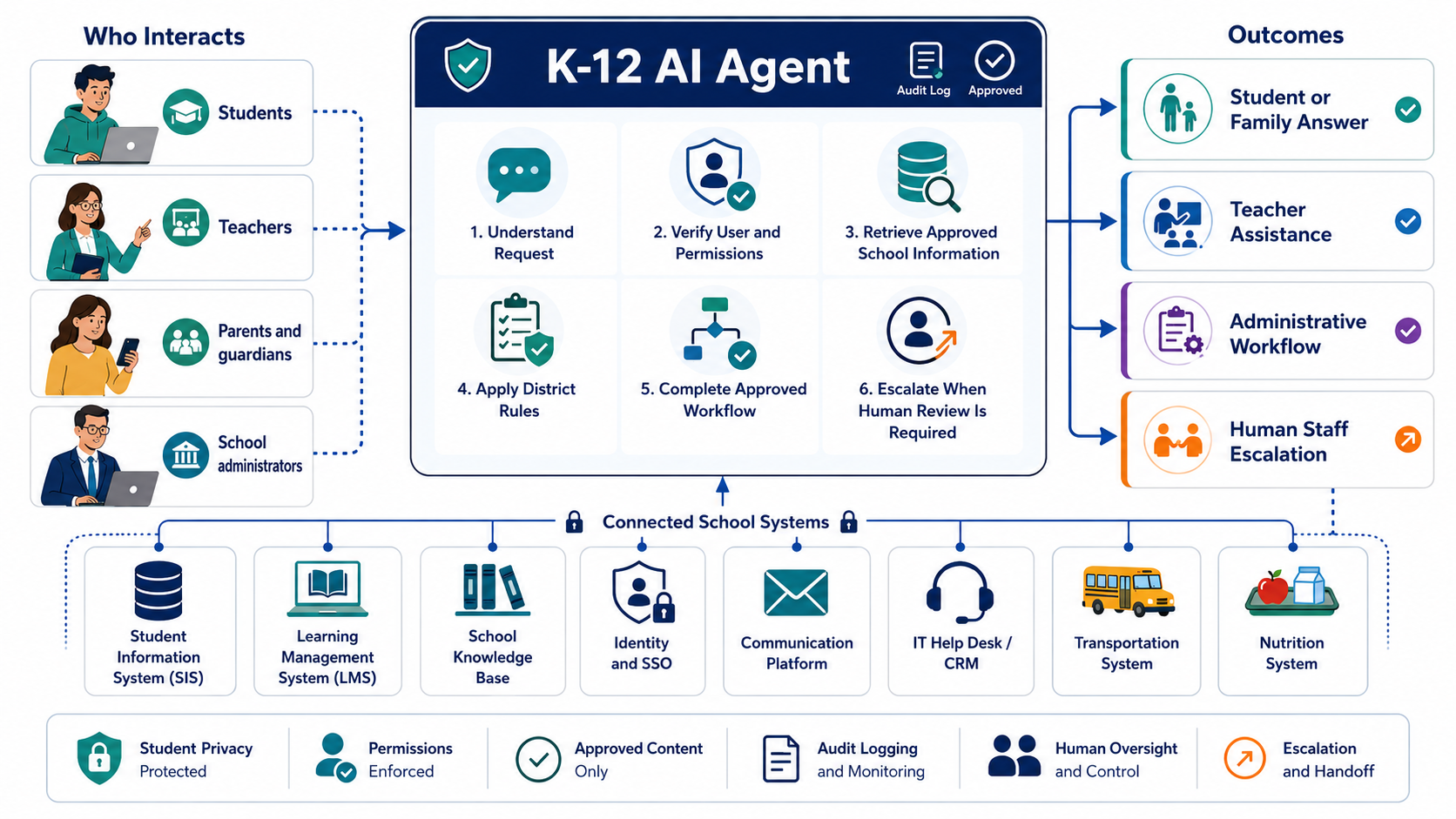
Ten practical use cases span learning support, teacher productivity, family engagement, student services, and school operations.
1. How Can AI Agents Support Personalized Tutoring?
AI agents can provide step-by-step explanations, practice questions, hints, and learning support using approved curriculum content and student-access rules.
They should support learning rather than simply provide answers, and teachers should determine how AI-generated support fits classroom instruction. Similar adaptive approaches are explored in Digiqt's AI Agents in Language Learning and AI Agents in Online Courses.
2. How Can AI Agents Help Teachers With Lesson Planning?
AI agents can help teachers draft lesson outlines, activity ideas, differentiated materials, discussion questions, and assessment drafts based on approved standards or curriculum resources.
Teachers should review generated material before classroom use rather than treating AI output as final instructional content.
3. How Can AI Agents Assist With Grading and Feedback?
AI agents can help organize rubric-based feedback, identify missing elements, summarize student work, and draft comments for teacher review.
Final grades and consequential academic judgments should remain under educator control, especially where context, accommodations, or subjective evaluation matter.
4. How Can AI Agents Improve Family Communication?
AI agents can answer routine questions about schedules, enrollment, policies, events, transportation, meals, and school services across approved communication channels.
They can also support multilingual communication when the district validates translation quality and provides a clear human escalation path. For adjacent conversational workflows, see Chatbots in K-12 Education.
5. How Can AI Agents Support Attendance Outreach?
AI agents can identify attendance-related workflow triggers, send approved reminders, provide practical information, and route recurring concerns to attendance staff or counselors.
The agent should support outreach and case preparation rather than independently determining truancy consequences or disciplinary action.
6. How Can AI Agents Assist Counseling and Student-Support Triage?
AI agents can collect non-diagnostic intake information, identify requests that require staff attention, provide approved resources, and escalate sensitive situations according to district procedures.
They should not act as autonomous counselors or make mental-health, safety, disciplinary, or crisis decisions. For career-oriented student support, see Digiqt's AI Agents in Career Counseling.
7. How Can AI Agents Improve the School IT Help Desk?
AI agents can answer common technical questions, collect troubleshooting details, guide users through approved fixes, create tickets, and route unresolved issues with conversation context attached.
This is often a practical starting point because the workflow is measurable and can be separated from sensitive academic decision-making. Digiqt's AI Agents in Student Engagement also shows how education-focused agents can connect student-facing support with operational systems and human escalation.
8. How Can AI Agents Support Enrollment and Registration?
AI agents can guide families through enrollment steps, explain required documents, track missing information, answer process questions, and route exceptions to registrars.
Identity, residency, eligibility, and other official determinations should continue to follow district rules and authorized staff workflows.
9. How Can AI Agents Support IEP and MTSS Administration?
AI agents can help authorized staff locate records, summarize approved information, prepare meeting materials, track administrative tasks, and surface missing documentation.
They should not determine eligibility, placement, accommodations, services, or other special-education decisions that require qualified human teams and applicable legal processes.
10. How Can AI Agents Support Transportation and Nutrition Services?
AI agents can provide approved information about bus routes, delays, schedules, menus, meal programs, and service requests when connected to the relevant operational systems.
They can also route exceptions such as route issues or account questions to the appropriate school team.
What School Systems Can AI Agents Integrate With?
K-12 AI agents can integrate with SIS, LMS, identity, communication, transportation, nutrition, CRM, help desk, and approved knowledge systems, depending on the workflow.
| System | Typical AI-Agent Use |
|---|---|
| SIS | Schedules, enrollment status, attendance, permitted student context |
| LMS | Assignments, learning content, progress, teacher workflows |
| Identity | Authentication, roles, guardian or staff access |
| Communication | Email, SMS, portal, notifications |
| Transportation/Nutrition | Routes, delays, menus, service information |
| Help Desk/CRM | Tickets, cases, routing, conversation history |
| Knowledge Base | Policies, handbooks, calendars, approved FAQs |
Where supported, standards can simplify integration. 1EdTech's OneRoster standard supports exchange of rostering, gradebook, and resource information through REST or CSV, while LTI supports standardized integration between learning platforms and external tools.
What Should K-12 AI Agents Automate vs Keep Human-Controlled?
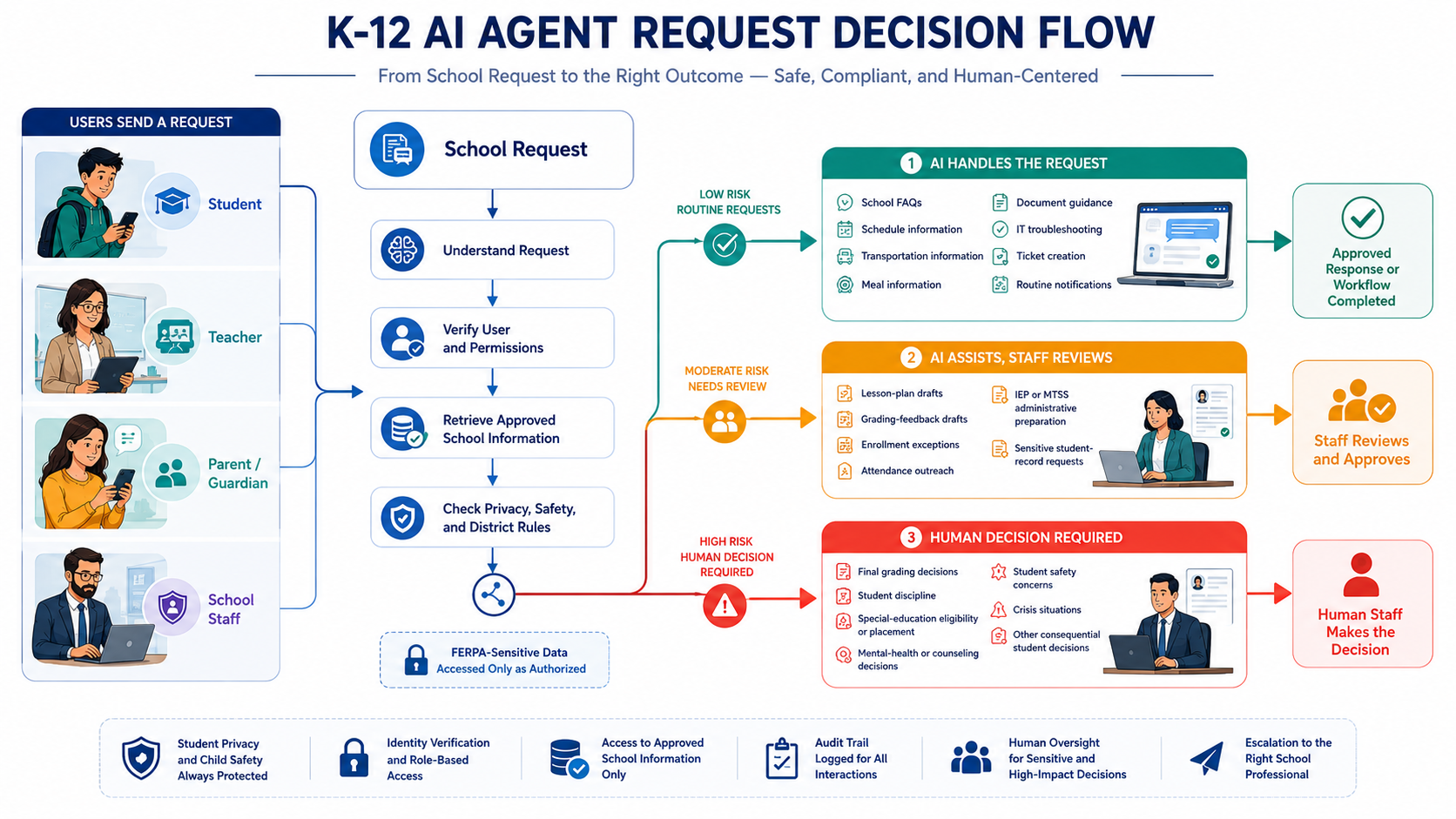
K-12 AI agents should automate low-risk, well-defined tasks while keeping academic, safety, disciplinary, special-education, and other high-impact decisions under appropriate human control.
| Level | Examples |
|---|---|
| AI can handle | FAQs, status checks, document guidance, ticket creation, approved notifications |
| AI can assist | Lesson drafts, rubric feedback drafts, enrollment guidance, attendance outreach |
| Human review required | Grades, sensitive student records, complex exceptions, counseling escalation |
| Human decision required | Discipline, special-education determinations, safety/crisis decisions, consequential student decisions |
The exact boundary should be defined by district policy, applicable law, user role, data sensitivity, and the consequence of an incorrect action.
What FERPA, COPPA, Privacy, and Security Controls Should Schools Consider?
K-12 AI deployments should be designed around applicable student-privacy obligations, vendor responsibilities, data minimization, access controls, security, retention, and human oversight rather than assuming an AI product is automatically compliant.
1. How Does FERPA Affect K-12 AI Agents?
FERPA governs access to and disclosure of education records at covered educational agencies and institutions, so districts should carefully control what student information an AI system can access and why.
The U.S. Department of Education explains that third-party providers may qualify under FERPA's school-official exception only when specific conditions are met, including direct control over use and maintenance of education-record information and restrictions on unauthorized use or redisclosure.
See the U.S. Department of Education's FERPA guidance and privacy guidance for education technology.
2. How Does COPPA Affect AI Tools Used by Children Under 13?
COPPA may apply to commercial websites and online services directed to children under 13, and to certain general-audience services with actual knowledge that they collect personal information from children under 13.
The FTC explains that schools may, in certain educational contexts, authorize collection on behalf of parents, but that authority is limited and does not permit an operator to repurpose children's information for unrelated commercial uses.
See the FTC's COPPA Rule and guidance.
3. What Security and Governance Controls Should a District Require?
Districts should apply security and governance controls that match the sensitivity of student information and the authority granted to the AI agent.
Useful controls include:
- least-privilege and role-based access
- approved data sources
- data minimization
- secure authentication and integrations
- audit logging
- retention and deletion rules
- vendor data-use restrictions
- human escalation for sensitive topics
- monitoring for unsupported or unsafe output
- documented fallback when the AI service is unavailable
The Department of Education notes that FERPA itself does not prescribe a specific technical security control set, but schools should take appropriate steps to safeguard student records.
Which K-12 AI Agent Should a District Deploy First?
A district should start with a frequent, measurable workflow that has accessible data, a clear operational owner, limited safety risk, and an easy fallback to the existing process.
| Main Problem | Practical First Use Case | KPI to Baseline |
|---|---|---|
| Repetitive family questions | Family information agent | Response time, escalations, staff effort |
| High IT ticket volume | IT help desk agent | Resolution time, self-service resolution |
| Enrollment friction | Enrollment support agent | Completion time, incomplete cases |
| Teacher admin burden | Teacher support agent | Time spent on selected workflow |
| Student support routing | Triage assistant | Routing time, escalation accuracy |
Do not begin with the most sensitive workflow simply because it appears more advanced. Start where the district can safely prove usefulness.
How Does Digiqt Implement AI Agents for K-12 Education?
Digiqt starts with one measurable workflow, limits initial system access, defines human-control boundaries, and validates the agent before expanding automation. You can also explore Digiqt's broader AI Agent library to see how task-specific agents are structured across workflows and industries.
1. How Does Digiqt Select the First K-12 AI Workflow?
Digiqt identifies a recurring problem with a measurable baseline, clear process owner, accessible data, and realistic integration scope.
2. How Does Digiqt Prepare School Content and Integrations?
The pilot uses approved policies, FAQs, curriculum or operational content and connects only the systems required for the selected workflow.
3. How Does Digiqt Define Safety and Escalation Rules?
The implementation specifies what the agent can answer, what data it can access, what actions it can take, and which situations must move to staff review.
4. How Does Digiqt Validate the Agent Before Scaling?
The pilot is tested against normal requests, edge cases, access rules, unsafe or unsupported outputs, escalation behavior, and agreed operational KPIs before broader rollout.
Have a K-12 workflow you want to evaluate for AI?
How Should School Districts Measure AI-Agent ROI?
School districts should calculate ROI from their own operating baseline rather than rely on universal savings percentages or deployment claims.
Useful measures include:
- response and resolution time
- repetitive ticket or inquiry volume
- staff time spent on the selected workflow
- enrollment or form-completion rates
- escalation rate
- answer accuracy or quality review
- user satisfaction, where already measured
- implementation and ongoing operating cost
A practical framework is:
Baseline → measured improvement → verified staff/capacity or service value → total AI-agent cost → ROI
For public-sector buyers, non-financial outcomes such as service accessibility, response consistency, staff capacity, and risk reduction may also be important alongside direct cost savings.
Is Your School District Ready for an AI-Agent Pilot?
A district is ready for a pilot when it has a defined problem, reliable approved content, accessible systems, clear ownership, privacy review, human escalation rules, and measurable success criteria.
Before starting, ask:
- Is the first workflow clearly defined?
- Can we measure the current process?
- Is approved content available?
- Is the required data accessible?
- Do we know what the AI can and cannot do?
- Are student-data permissions defined?
- Is there a human escalation and fallback process?
- Do we know what success looks like?
If several answers are no, the first project may be data, policy, or integration readiness rather than AI deployment.
Conclusion
AI agents can support K-12 education across tutoring, teacher workflows, family communication, enrollment, IT support, attendance, and school operations.
The strongest implementation is not the one that automates the most tasks. It is the one that solves a measurable problem, uses approved information, protects student data, integrates with existing systems, and keeps high-impact decisions under appropriate human control.
Want to identify the safest and most valuable starting point for your district or edtech platform?
Frequently Asked Questions
1. What Are AI Agents in K-12 Education?
AI agents in K-12 education are software systems that use approved school data, policies, and connected tools to support students, teachers, families, and administrators with defined tasks and workflows.
2. What Are the Main Use Cases of AI Agents in K-12 Education?
Common use cases include tutoring, lesson planning, grading support, family communication, attendance outreach, counseling triage, IT help desk, enrollment, IEP and MTSS administration, and transportation or nutrition support.
3. Do K-12 AI Agents Automatically Comply With FERPA and COPPA?
No. Compliance depends on how the system is designed, what data it accesses, who operates it, how consent and disclosure rules apply, and the district's policies and legal obligations.
4. What Systems Can K-12 AI Agents Integrate With?
K-12 AI agents can integrate with SIS, LMS, identity, communication, transportation, nutrition, CRM, help desk, and approved knowledge systems through supported APIs and interoperability standards.
5. Can AI Agents Make Decisions About Students?
Low-risk administrative workflows may be automated within defined rules, but grading, discipline, special education, safety, counseling, and other high-impact decisions should remain under appropriate human oversight.
6. How Should a School District Test an AI Agent?
Start with one measurable low-risk workflow, use approved content and limited permissions, test edge cases and escalation behavior, monitor outputs, and expand only after the pilot is validated.
7. How Should School Districts Measure AI-Agent ROI?
Compare baseline and post-deployment metrics such as response time, ticket volume, staff effort, completion rates, escalation rates, and service quality, then calculate value against implementation and operating costs.
8. Which K-12 AI-Agent Use Case Should a District Deploy First?
Start with a frequent, measurable workflow that has accessible data, a clear owner, limited student-safety risk, and an obvious fallback process, such as family FAQs, IT triage, or enrollment support.
Sources
- U.S. Department of Education: What is FERPA?
- U.S. Department of Education: Privacy and Education Technology
- U.S. Department of Education: Data Security for K-12 and Higher Education
- FTC: Children's Online Privacy Protection Rule (COPPA)
- FTC: Complying with COPPA FAQs
- 1EdTech: OneRoster 1.2 Standard
- 1EdTech: LTI Core