Banking Fraud Detection 2026: Why Rules Alone Aren’t Enough
Banking fraud detection is the process banks use to identify fraudulent transactions, accounts, and behaviors in real time, before money leaves the institution. In 2026, effective programs combine machine learning, behavioral analytics, device intelligence, and network (graph) analysis across every payment rail, while meeting Nacha's new fraud monitoring rules and the revised federal model risk guidance.
Fraud has moved from an operational nuisance to a board-level risk. U.S. consumers reported record losses last year, criminals are using generative AI to scale their attacks, and regulators have raised expectations for how banks monitor payments. For CROs, CFOs, heads of fraud, and bank executives, the question about fraud detection in banking is no longer whether to modernize. It is how quickly you can do it without adding friction for legitimate customers.
This guide covers the current threat landscape, how modern detection works, what U.S. regulators now expect, how to measure ROI, and a practical roadmap for getting there.
What Is Banking Fraud Detection?
Banking fraud detection is the set of technologies, data, and processes a financial institution uses to spot and stop unauthorized or deceptive activity. That includes fraudulent payments, account takeovers, fake identities, check fraud, and insider abuse, ideally before a loss occurs.
It differs from bank fraud prevention, which focuses on blocking attacks at the front door (for example, strong authentication at onboarding), and from AML transaction monitoring, which focuses on money laundering and suspicious activity reporting. In practice, leading banks are converging all three into a single fraud-and-financial-crime (FRAML) view of the customer.
Why Banking Fraud Detection Is a Board-Level Priority in 2026
The numbers explain the urgency.
- Consumer losses hit a record. The FTC's Consumer Sentinel Network received roughly 3 million fraud reports in 2025, with consumers reporting a record $15.9 billion in losses, up from more than $12 billion in 2024. Reported losses do not capture every fraud incident. In separate modeling cited by the FTC, broader 2024 consumer fraud losses were estimated to be potentially much higher because many incidents are never reported.
- Bank transfers remain a high-loss payment channel. FTC data for 2024 showed consumers reported more losses through bank transfers or payments than through any other listed payment method, followed by cryptocurrency. The pattern underscores why payment monitoring remains central to fraud prevention.
- Criminals are impersonating banks. Business impersonators accounted for nearly $1 billion in reported losses in 2025, with bank impersonators driving the highest losses in that category. Many of these scams begin with a fake security alert that persuades people to move money to "protect" it.
- Cyber-enabled fraud is surging. The FBI's IC3 2025 report recorded $20.9 billion in losses, a 26% year-over-year increase, with nearly 85% of losses tied to cyber-enabled fraud rather than malware. Business email compromise (BEC) alone accounted for about $3.05 billion.
- AI is now a tracked threat vector. For the first time, IC3 logged AI-related crime as its own category, with 22,364 complaints and about $893 million in losses.
Commercial clients feel it too. According to the 2026 AFP Payments Fraud and Control Survey, 76% of U.S. organizations experienced attempted or actual payments fraud in 2025, yet only 17% use AI to fight it. Paper checks were the most targeted method (58%), followed by ACH debits (30%) and wire transfers (25%), and BEC affected 74% of organizations surveyed.
What this means for bank leaders: Your treasury management clients are under attack and looking to their bank for protection. Fraud detection capability is increasingly a competitive differentiator in commercial banking, not just a cost center.
The Fraud Types U.S. Banks Must Detect
| Fraud type | How it works | Key detection signals |
|---|---|---|
| Check fraud | Stolen, washed, altered, or counterfeit checks deposited via branch, ATM, or mobile | Image anomalies, payee/amount mismatches, new-account deposit velocity, duplicate presentment |
| Authorized push payment (APP) / impersonation scams | Customers are manipulated into sending money themselves via ACH, wire, Zelle, RTP, or FedNow | Out-of-pattern payee, first-time large transfer, active phone call during session, hesitation behavior |
| Business email compromise (BEC) | Spoofed or compromised emails change vendor payment instructions | Beneficiary account changes, new payee plus urgent wire, payee name and account mismatch |
| Account takeover (ATO) | Criminals use stolen credentials or hijacked sessions to access accounts | New device or location, credential stuffing patterns, contact-detail changes before transfers |
| Synthetic identity fraud | Fabricated identities combine real and fake data to open accounts and build credit | Thin or inconsistent credit files, shared attributes across applications, bust-out patterns |
| Money mule networks | Accounts receive and quickly move illicit funds | Rapid in-and-out flows, many unrelated senders, graph links to known fraud accounts |
| Insider/employee fraud | Staff abuse access to manipulate accounts or data | Unusual access, overrides, dormant-account activity, off-hours behavior |
| Card fraud | Card-not-present fraud, skimming, and enumeration attacks | Merchant-category anomalies, velocity bursts, BIN attack patterns |
Fraud rarely stays in one channel. A single scheme can start with a phishing text, move to account takeover, and end in a wire transfer to a mule account. That is why siloed, channel-by-channel detection keeps failing. And because checks remain the most targeted payment method for commercial clients, check fraud detection deserves its own models for image analysis, deposit velocity, and new-account risk, not just a handful of legacy rules.
Why Rules-Based Fraud Detection Is No Longer Enough
Most U.S. banks still rely heavily on static rules, such as "flag any wire over $10,000 to a new payee." Rules remain useful, but on their own they create three problems.
- High false positives. Broad rules can flag large volumes of legitimate activity, frustrating customers, driving up call-center costs, and burying investigators in low-value alerts. This is where false-positive alert reduction becomes operationally important.
- Easy to game. Fraudsters test thresholds and stay just below them. Once a rule is known, it stops working.
- Blind to scams. In APP fraud, the genuine customer logs in on their own device and approves the payment. Credentials, device, and location all look legitimate, so authentication-based rules see nothing wrong.
The answer is not to throw rules away, but to layer them with adaptive, data-driven models that understand context.
How Modern Banking Fraud Detection Works
Modern AI fraud detection for banks uses a layered architecture in which each layer catches what the others miss.
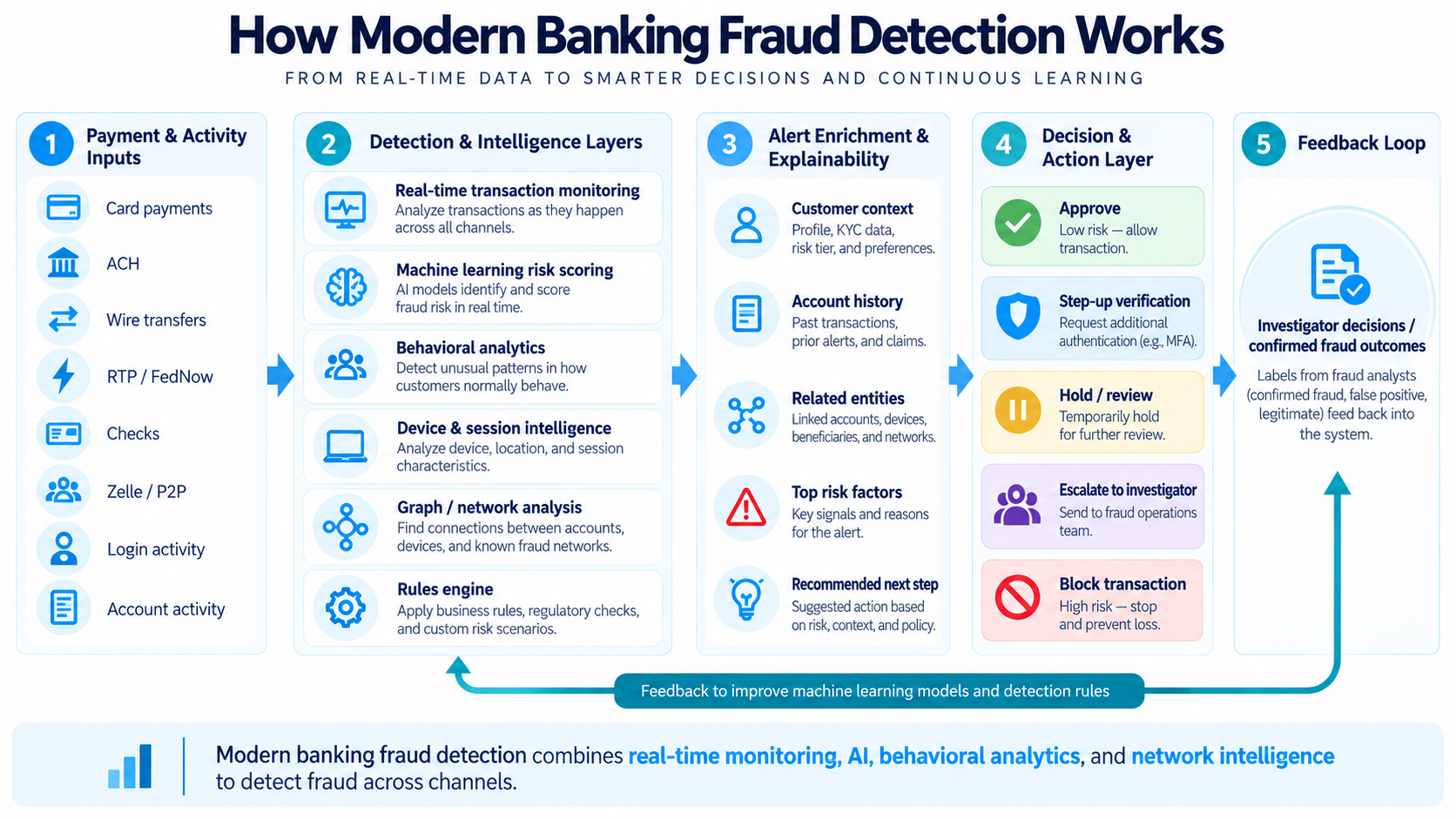
1. Real-time transaction monitoring
In a modern real-time architecture, eligible payment events can be scored before authorization or settlement where the payment rail, available data, and bank integration support pre-settlement decisioning. This is especially important for instant payments, where the window for intervention can be very short. For a deeper look at this workflow, see our guide to AI agents for payments.
2. Machine learning risk scoring
Supervised models can learn from historical confirmed fraud, while unsupervised techniques can surface unusual patterns that do not match established behavior. Used alongside rules and other risk signals, these approaches can identify patterns that a single static rule may miss.
3. Behavioral analytics and biometrics
Depending on the bank's digital channels, permissions, and privacy framework, behavioral models may use signals such as typical login times, navigation patterns, payees, transaction amounts, and other interaction data. A significant deviation from an established pattern can contribute to a higher fraud-risk score.
4. Device and session intelligence
Where the bank's technology stack and applicable privacy controls permit, device fingerprinting, remote-access-tool detection, emulator signals, and other session indicators can add context when assessing account takeover or coached-scam risk.
5. Graph and network analysis
Link analysis connects accounts, devices, phone numbers, addresses, and beneficiaries to expose mule networks and synthetic identity rings that look normal when viewed individually.
6. Explainable AI and investigator tooling
Every alert should show why it fired, including the top contributing factors, related entities, and recommended next steps. This speeds investigations and supports examiner review.
7. Continuous feedback loops
Investigator decisions and confirmed fraud outcomes feed back into the models, so detection improves as fraudsters adapt.
For a closer look at the AI-specific techniques behind these controls, see our guide to AI fraud detection use cases in banking.
The 2026 U.S. Regulatory Landscape for Fraud Detection
Regulatory expectations changed significantly this year. Here is what bank leaders need to know.
Nacha's ACH fraud monitoring rules are now in force
Nacha's risk management amendments require all ODFIs, and non-consumer Originators, Third-Party Service Providers, and Third-Party Senders, to establish and implement risk-based processes and procedures reasonably intended to identify ACH entries initiated due to fraud. Phase 1 took effect on March 20, 2026, covering all ODFIs, high-volume originators and third parties, and RDFIs whose 2023 ACH receipt volume exceeded 10 million entries. Because June 19 is a federal holiday, Phase 2 took practical effect on June 22, 2026, extending the requirements to all remaining participants.
Two points matter most for decision-makers:
- Receiving banks are now accountable. Nacha has noted that this is the first time RDFIs have a monitoring role alongside ODFIs, Originators, and third parties, because credit-push fraud requires both sides of a payment to participate.
- The rules are technology-neutral. Nacha does not mandate specific methods, but cites options such as velocity checks, anomaly detection, behavioral tolerances, and pattern recognition. Processes and procedures must be reviewed at least annually.
Model risk management guidance has been overhauled
On April 17, 2026, the OCC, Federal Reserve, and FDIC replaced most of SR 11-7 with new interagency guidance, issued as SR 26-2 (OCC Bulletin 2026-13; FDIC FIL-15-2026). Key changes include a narrower definition of "model," a more risk-based approach, and explicit exclusion of generative and agentic AI from this specific guidance. The Federal Reserve says the guidance is expected to be most relevant to banking organizations with more than $30 billion in total assets, while it may also be relevant to smaller organizations with significant exposure to model risk. The revised guidance also supersedes the 2021 interagency statement on model risk management for BSA/AML systems.
For fraud leaders, this is good news with a caveat. Traditional machine learning fraud models can now be governed in proportion to their materiality. However, the agencies plan a separate request for information on AI model risk, and until that produces guidance, there is no dedicated framework for generative or agentic AI. Banks deploying these technologies in fraud operations should still apply sound governance, documentation, and human oversight.
Regulators are focused on check and payments fraud
In June 2025, the OCC, Federal Reserve, and FDIC issued a request for information on potential actions to address payments fraud, with particular focus on check fraud and coverage of ACH, wire, and instant payments. Expect continued supervisory attention to how banks detect, respond to, and share information about payments fraud, with check fraud detection likely to stay near the top of examiner agendas.
Existing obligations still apply
Fraud detection also supports ongoing BSA/AML duties (including SAR filing with FinCEN), Regulation E error-resolution obligations for consumer electronic transfers, and UDAAP expectations. A unified detection platform makes these obligations easier to evidence during exams.
How to Measure the ROI of Banking Fraud Detection
Decision-makers should evaluate fraud detection on both loss reduction and operational efficiency. Track these KPIs before and after deployment:
| KPI | What it measures | Why it matters |
|---|---|---|
| Fraud loss rate (basis points of volume) | Net losses relative to transaction volume | The headline measure of effectiveness |
| Detection rate | Share of confirmed fraud caught before loss | Shows model coverage |
| False positive ratio | Legitimate transactions flagged per true fraud | Drives customer friction and operating cost |
| Alert-to-decision time | Speed from alert to investigator decision | Critical for instant payments |
| Cost per investigation | Analyst hours and tooling per case | Captures efficiency gains |
| Customer abandonment and complaints | Friction caused by declines and holds | Protects revenue and customer loyalty |
| Recovery rate | Share of fraudulent funds recovered | Reflects response speed and interbank coordination |
False-positive reduction can create value in two places at once: it can reduce unnecessary investigation workload and lower customer friction from legitimate activity being delayed or declined. The financial impact should be measured against each bank's own baseline rather than assumed in advance.
What Banks Should Evaluate Before Modernizing Fraud Detection
When evaluating vendors or internal builds, U.S. bank leaders should ask these questions:
- Can it connect risk signals across payment rails? Check, ACH, wire, card, Zelle, RTP, and FedNow may run through different systems, but the bank should be able to connect relevant risk signals instead of treating each channel in isolation.
- Can it support the decision window required by the payment rail? For instant payments, fraud controls may need to operate within a very short intervention window, so latency and integration design should be tested against the bank's actual payment flow.
- Does it detect scams, not just unauthorized access? Ask specifically how the solution identifies APP fraud where the genuine customer is transacting.
- Is it explainable? Investigators and examiners should be able to see why each alert fired.
- Does it integrate with your stack? Look for proven connectors to your core (Fiserv, FIS, Jack Henry, and others), digital banking platform, and case management system.
- How does it handle governance? Request model documentation, validation support, and monitoring that align with the revised interagency model risk guidance.
- What is the time to value? A phased deployment can start with one clearly defined use case so the bank can measure detection performance, false positives, operational impact, and governance requirements before expanding.
- Does it support Nacha compliance? The solution should help document risk-based procedures and support annual reviews.
An Illustrative 90-Day Pilot Roadmap for Banking Fraud Detection
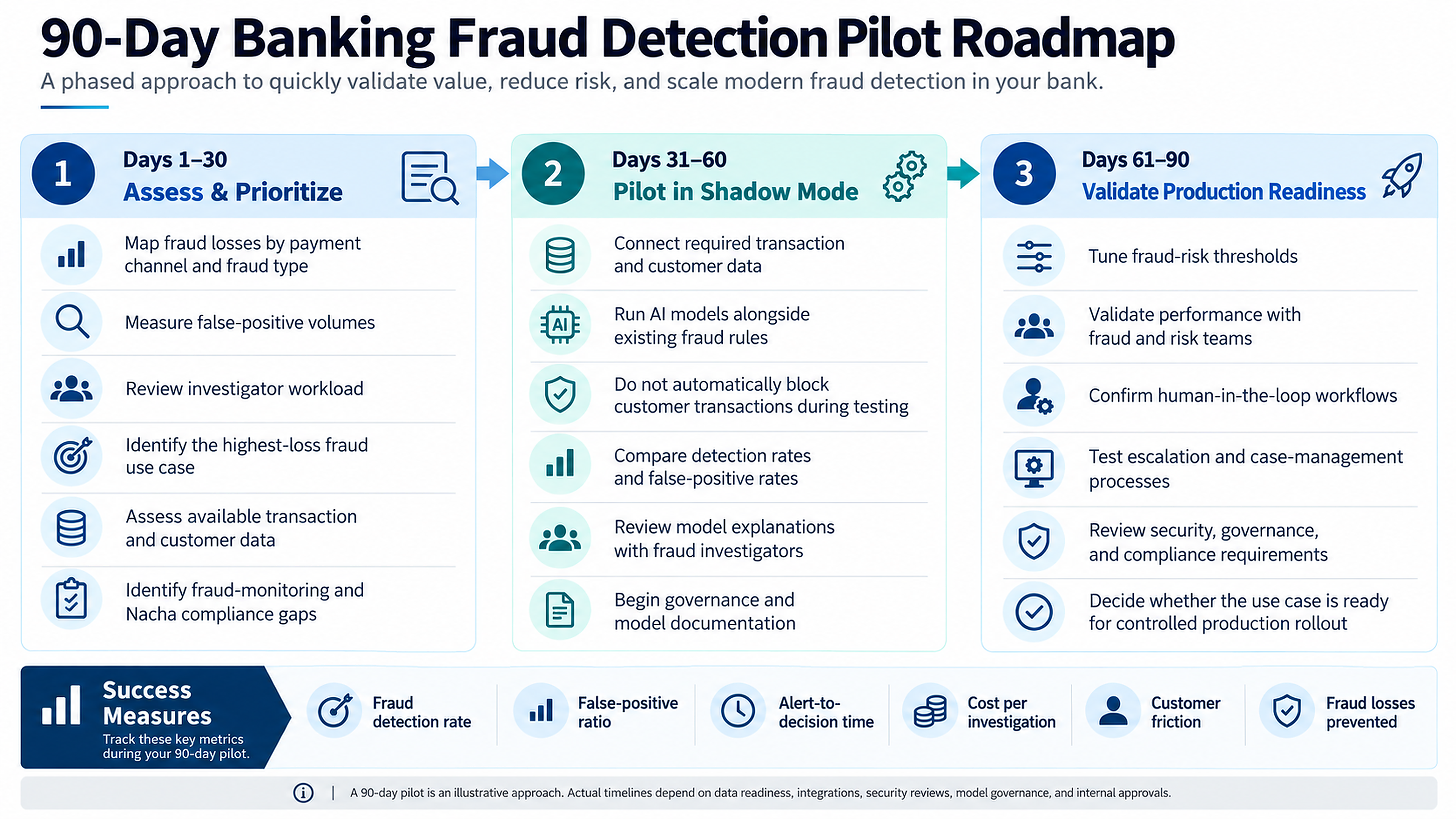
Days 1–30: Assess and prioritize. Map fraud losses by channel and typology. Quantify false positive volumes and investigator workload. Identify your single highest-loss use case (for many banks, check fraud or APP scams) and confirm any Nacha compliance gaps.
Days 31–60: Pilot in shadow mode. Run AI models alongside existing rules without affecting customer decisions. Compare detection and false positive rates side by side, and build governance documentation from day one.
Days 61–90: Validate readiness for production. If data quality, model performance, security review, governance, and operational controls meet the bank's requirements, move the pilot use case toward production with appropriate human oversight. Otherwise, use the findings to refine the model and integration before launch.
How Digiqt Helps Banks Modernize Fraud Detection
Digiqt Technolabs builds custom AI, data, and software solutions for financial-services organizations. Rather than requiring a bank to replace its existing fraud platform, Digiqt can build intelligence and workflow layers that integrate with existing fraud, core banking, KYC/CDD, data, and case-management systems:
- AML transaction monitoring agents ingest data from wires, ACH, card transactions, cash, internal transfers, and digital payments through real-time streams or batch processing.
- False positive alert reduction agents can connect to core banking, CIF, KYC/CDD, and data warehouse systems to enrich alerts with additional customer and transaction context for investigator review.
- Payments fraud agents can combine behavioral, device, transaction, velocity, and network signals to support real-time or near-real-time fraud decisioning, depending on the bank's architecture and payment rail.
- Employee fraud detection agents establish behavioral baselines for every employee and alert on deviations consistent with insider fraud.
- Card dispute automation agents integrate with fraud platforms such as FICO Falcon, Featurespace, and Feedzai to cross-reference disputes against known fraud patterns.
A staged deployment can begin with a clearly defined use case and measurable baseline, then expand only after the bank validates detection performance, operational impact, governance, and integration readiness. Human oversight can be retained wherever policy or risk requires it.
Conclusion: Detection Is Now a Competitive Advantage
Reported fraud losses are at record highs, AI can make social-engineering content easier to produce at scale, and U.S. payment-monitoring expectations have expanded. Static rules remain an important control, but relying on them alone can make it harder to adapt to changing fraud patterns while controlling false positives and investigator workload.
Banks that modernize banking fraud detection can combine rules with real-time data, explainable models, network analysis, and investigator feedback to improve how suspicious activity is prioritized and reviewed. The strongest programs measure success against fraud loss, detection coverage, false positives, customer friction, and operational cost.
Frequently Asked Questions
What is banking fraud detection?
The use of technology, data, and processes to identify and stop fraudulent transactions, accounts, and behaviors, such as check fraud, account takeover, scams, and synthetic identities, before they cause losses.
How does AI detect fraud in banking?
By analyzing transaction, behavioral, and device data in real time. Machine learning models can learn normal patterns, flag anomalies, and connect related accounts through graph analysis to surface suspicious relationships that static rules may miss.
What is the most common type of bank fraud in the U.S.?
Imposter scams were the most frequently reported fraud category to the FTC in 2025, and bank impersonators generated the highest reported losses among business impersonators. Among business payments, checks remained the most targeted method in the 2026 AFP survey.
What are the Nacha fraud monitoring rules for 2026?
ODFIs, RDFIs, non-consumer Originators, and certain third parties must implement risk-based processes intended to identify ACH entries initiated due to fraud. Phase 1 began March 20, 2026, Phase 2 took practical effect June 22, 2026, and processes and procedures must be reviewed at least annually.
Does the new model risk guidance apply to AI fraud detection models?
The April 2026 interagency guidance (SR 26-2) applies to traditional statistical and quantitative models and non-generative, non-agentic AI models. It is expected to be most relevant to banking organizations with more than $30 billion in assets, although it may also be relevant to smaller institutions with significant model risk. Generative and agentic AI are outside the scope of this specific guidance, but banks should still apply appropriate governance and controls.
Why are rules-based fraud systems no longer enough on their own?
Static rules remain useful, but they can generate false positives, can be tested and evaded, and may miss authorized scams in which the genuine customer approves a payment from a trusted device. Banks increasingly layer rules with behavioral, device, network, and machine-learning signals.
How can banks reduce false positives in fraud detection?
Banks can combine existing rules with machine learning, behavioral analytics, customer context, alert enrichment, and investigator feedback so that higher-risk cases receive more attention while legitimate activity is less likely to be interrupted.
How long does it take to implement AI fraud detection?
Implementation time depends on data readiness, security review, model governance, vendor onboarding, and integration complexity. A focused 90-day pilot can be a useful planning model for a narrow use case, but enterprise-wide deployment may take considerably longer.
Sources
- Federal Trade Commission — FTC Testimony on Efforts to Combat Fraud (March 2026)
- Federal Trade Commission — 2025 Imposter Scam Loss Data (June 2026)
- FBI Internet Crime Complaint Center — 2025 IC3 Annual Report
- Association for Financial Professionals — 2026 Payments Fraud and Control Survey
- Nacha — Risk Management Topics: Fraud Monitoring Phase 1
- Nacha — Risk Management Topics: Fraud Monitoring Phase 2
- Nacha — New Risk Management Rules Now in Effect
- Nacha — Credit-Push Fraud Monitoring Resource Center
- Federal Reserve — Interagency Guidance on Model Risk Management, SR 26-2
- Federal Register — Request for Information on Potential Actions to Address Payments Fraud