AI Sales Training for Automotive Dealerships as EV Sales Jump 94%
India's electric car sales nearly doubled in a year. But buying an EV raises questions a brochure cannot answer: real-world range, home charging, battery fees, warranty transfer. In most showrooms, the person expected to answer them is the salesperson.
This article covers three things:
- what Indian EV buyers actually worry about
- what research shows happens when salespeople can't answer
- a practical standard for measuring EV sales readiness
It also explains where AI sales training for automotive dealerships helps, and where it doesn't.
Key takeaways
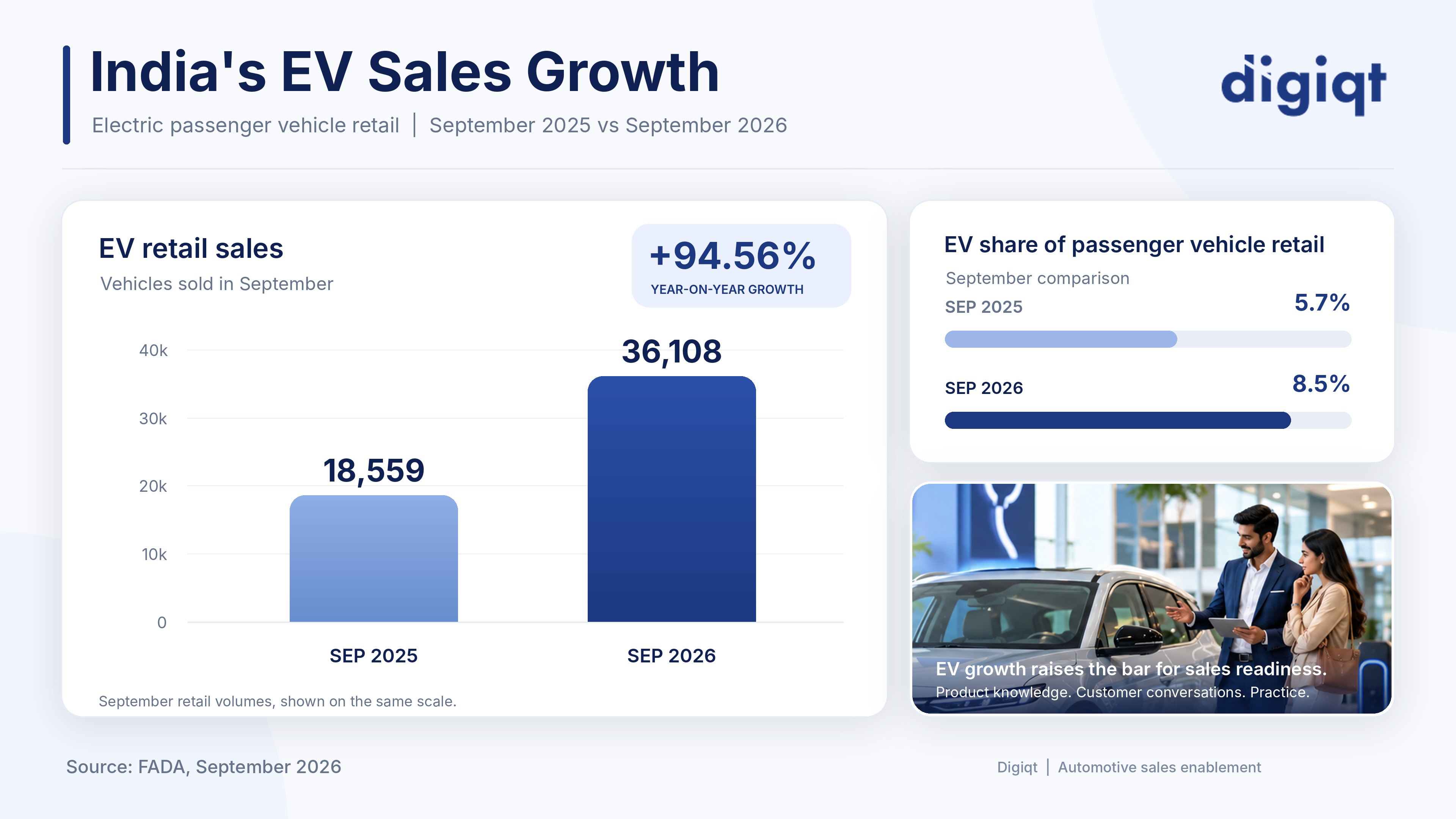
- Electric passenger vehicle retail in India reached 36,108 units in September 2026. That is up 94.56% year on year, taking the EV share of car sales to 8.5% (FADA).
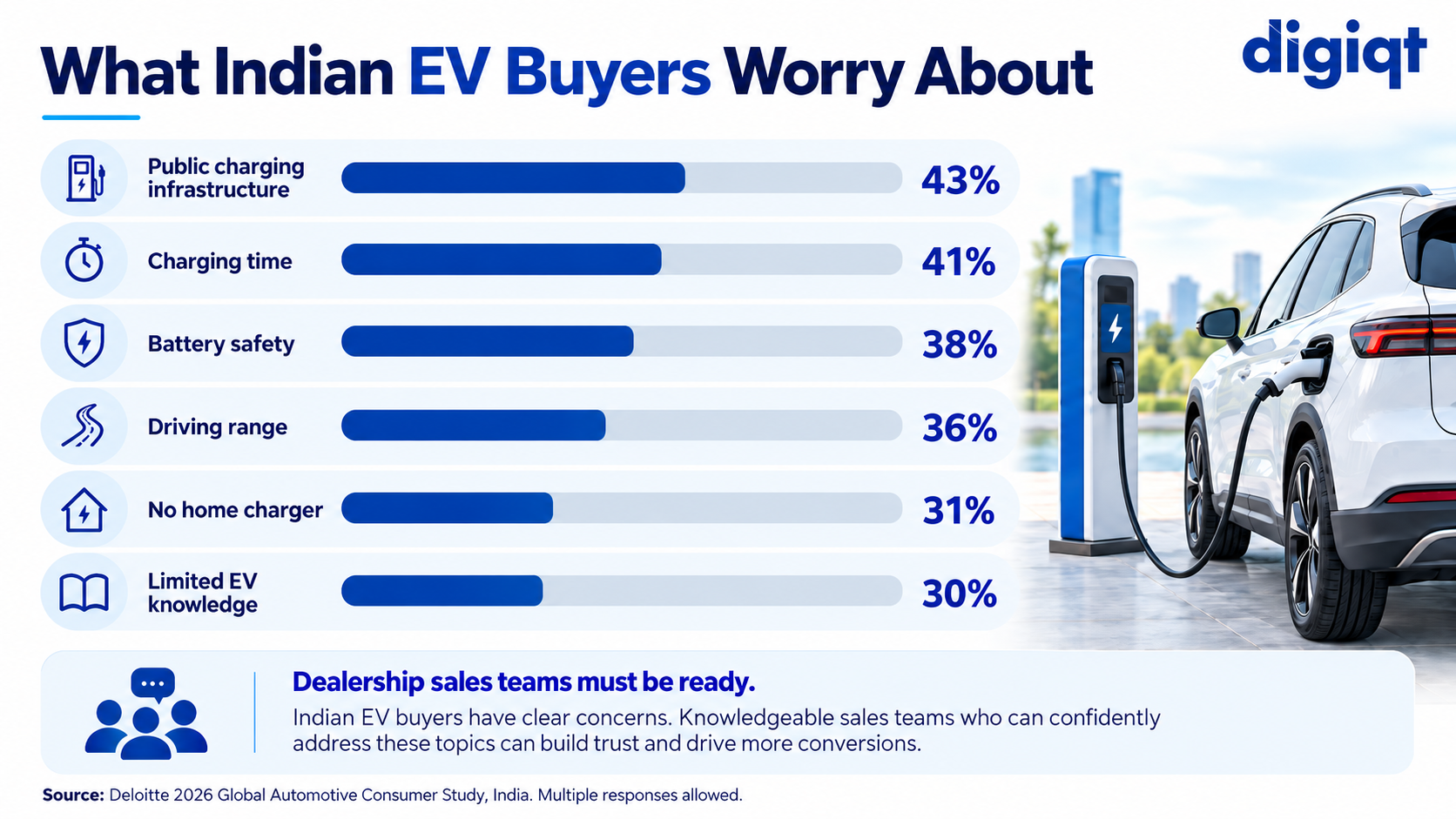
- Indian buyers' top EV concerns are public charging infrastructure (43%), charging time (41%) and battery safety (38%) (Deloitte, 2026).
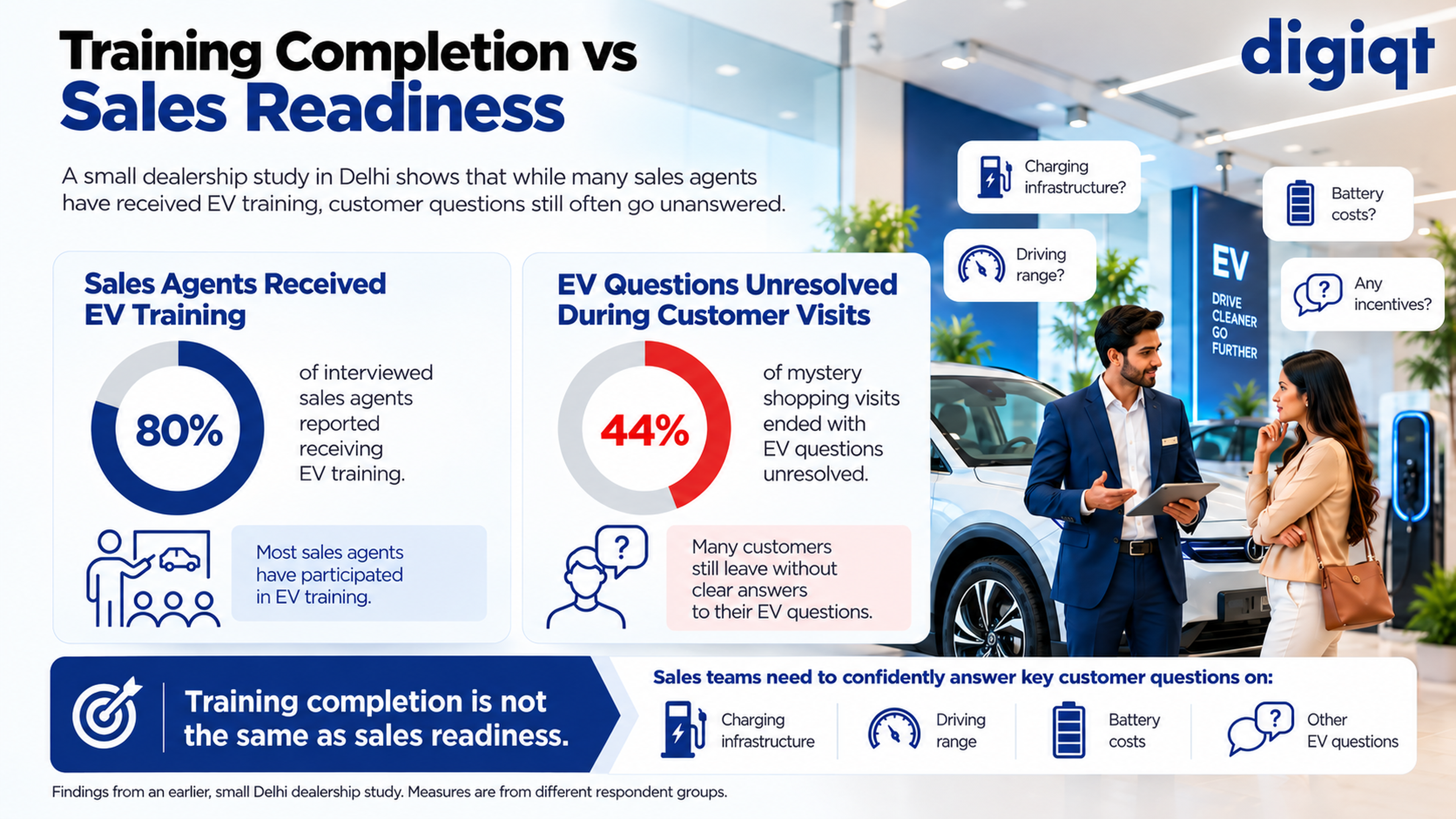
- In a Delhi dealership study, about 80% of sales agents said they had received EV training, yet 44% of mystery shoppers left with their EV doubts unresolved.
- Completing training shows attendance, not readiness. The real test is whether a salesperson gives accurate ownership advice.
- AI sales roleplay lets salespeople practise difficult EV conversations before they meet real customers, as long as it runs on manufacturer-approved information.
How Fast Are EV Sales Growing in India?
According to FADA data for September 2026:
- 36,108 electric passenger vehicles were retailed in September 2026, an all-time monthly record.
- That is up 94.56% from 18,559 in September 2025.
- EVs made up 8.5% of passenger vehicle retail, up from 5.7% a year earlier.
Reading the numbers carefully. FADA cautioned that industry-wide growth in September should be read against a weak base, because many buyers in September 2025 delayed purchases ahead of GST 2.0. For EVs, though, the growth is not just a base effect. The September figure was a record in absolute terms, and the EV share of car retail rose by almost three percentage points.
Even so, EVs are still fewer than one in ten cars sold. That is why showroom readiness matters now. As EVs move from early adopters to mainstream buyers, more customers will walk in with ownership questions, not spec-sheet questions.
Why Is Buying an EV a Different Kind of Decision?
Rahul is a hypothetical buyer, used here to illustrate the challenge.
- Rahul drives about 45 km a day and lives in an apartment.
- He sometimes drives between cities on weekends.
- He asks: "The brochure says over 450 km of range. Will I get that on the highway? And what if my society won't allow a charger?"
These are not specification questions. They are ownership questions. To answer well, a salesperson needs to understand Rahul's routine, not just the car. That is the core difference between selling an EV and selling a petrol or diesel car.
What Do Indian EV Buyers Still Worry About?
In Deloitte's 2026 Global Automotive Consumer Study: India findings, 1,346 respondents in India shared their concerns about battery electric vehicles. These are the concerns most relevant to dealership sales teams:
| Concern | Share of respondents |
|---|---|
| Lack of public charging infrastructure | 43% |
| Time required to charge | 41% |
| Battery safety | 38% |
| Driving range | 36% |
| No charger at home | 31% |
| Lack of knowledge about EVs | 30% |
Respondents could pick more than one concern.
Four findings matter most for sales teams:
- EV knowledge is still a gap. 30% of respondents listed limited understanding of EVs or EV technology among their concerns.
- The showroom is a key information source. 46% of Indian respondents named dealership visits as a source of information for their next vehicle.
- Money is not the only motivator. Among people considering an EV, 49% cited a better lifestyle experience. That is slightly more than the 47% who cited lower fuel costs.
- Dealerships are trusted. About 58% of Indian vehicle owners say they trust a dealership more than the manufacturer or their finance provider. That trust is exactly what one wrong answer can damage.
What this means: these are customer concerns, not proof that salespeople are failing. But they show exactly what an EV salesperson must be ready to explain.
What Happens When an EV Salesperson Can't Answer?
An earlier study by Ashoka University's Centre for Social and Behaviour Change (CSBC) examined EV sales at car dealerships in Delhi, a city with high EV adoption and an extensive charging network. Researchers held in-depth interviews with dealership managers and sales agents, then carried out mystery shopping visits, posing as customers to see how EVs were actually being sold.
The most striking finding is this: about 80% of the sales agents interviewed said they had received EV training. Yet in the mystery shopping visits:
- 44% of mystery shoppers left with their EV doubts unresolved.
- Agents showed clear gaps on public charging, charging costs, long-term savings, and government incentives. Many were unaware of any public charging stations in Delhi.
- Government incentives, such as registration fee waivers, rarely came up unless shoppers asked, and some agents then gave incorrect information.
- No mystery shopper was shown an electric car unless they asked about one, and first-time buyers were discouraged from considering an EV.
- In interviews, agents said they would only recommend EVs to people driving more than 80 km a day.
An important limitation: the study looked at one city, at a time when only 11 non-luxury EV models were on sale in India. It cannot describe today's dealerships across the country.
What it does show is the core lesson for EV product knowledge training. The training had happened, but readiness had not. Salespeople have to be able to apply what they learn, confidently and accurately, in a live customer conversation.
If a mystery shopper walked into your showroom tomorrow, would their EV questions get answered?
Find the gaps in your sales team's EV knowledge before your customers do
4 EV Buyer Questions Your Salespeople Must Get Right
"How far will it really go?"
Tata's Punch.ev with the 40 kWh battery has two official range figures:
- 468 km is the ARAI-certified range under standard test conditions.
- About 355 km is Tata's own "C75" real-world estimate. It reflects the range that 75% of customers could expect, based on past usage data.
Both figures are legitimate. They simply answer different questions. A salesperson who only quotes 468 km has not answered what Rahul actually asked.
What a strong answer sounds like: "The certified range is 468 km under test conditions. Tata's own real-world estimate is about 355 km. On your 45 km daily drive, that's roughly a week of commuting per full charge. For weekend highway trips, plan around the real-world figure, and let's check the chargers on your route."
"What will it actually cost me?"
EV ownership models are getting more complex, and Battery-as-a-Service (BaaS) terms differ by brand:
- Hyundai's CRETA Electric starts at ₹18,02,800 if bought outright. Under Hyundai's BaaS option, it starts at ₹10.99 lakh (ex-showroom), plus a battery EMI from ₹3.9 per km.
- Maruti Suzuki's e-Vitara also starts at ₹10.99 lakh under BaaS, with the battery fee starting slightly higher, at ₹3.99 per km.
- Tata's Punch.ev under BaaS starts at ₹6.49 lakh, with a battery EMI of ₹2.6 per km.
A lower starting price is not the full cost. Here is an illustrative calculation for Rahul with the CRETA Electric:
- At about 45 km a day, he drives roughly 1,350 km a month.
- At the advertised starting rate of ₹3.9 per km, the battery fee alone would be around ₹5,265 a month.
- That is before charging costs and before his weekend trips.
Hyundai's own BaaS explainer uses the same per-km method. His actual figure would depend on the financing terms. The point is that the salesperson should run this calculation with the customer, not leave them to discover it after purchase.
Charging cost matters to buyers too. In a separate Deloitte question, 85% of 266 Indian respondents said charging cost is important when choosing a public charging location.
"What does the battery warranty cover?"
Battery warranty terms differ by brand and model:
- Hyundai offers 8 years or 1,60,000 km on the CRETA Electric battery.
- Tata offers a lifetime battery warranty with unlimited kilometres on the Punch.ev's 40 kWh pack. "Lifetime" means 15 years from first registration, and it applies to the first private owner, with the vehicle registered in an individual's name. A later owner is covered under different terms.
Neither is simply "better." What matters is that the salesperson knows the exact conditions instead of making blanket promises. That includes eligibility rules and what happens to the warranty if the car is resold.
"Where will I charge?"
In a written reply to the Lok Sabha on 21 July 2026, the government said India had 52,718 public charging stations. Of these, 16,561 had fast chargers for cars, which is fewer than a third.
A national count does not tell Rahul whether there is a working charger on his route. It also doesn't tell him whether his housing society will allow a home charger, and that is a common gap. Deloitte found that 43% of Indian respondents who plan to charge at home don't yet have access to a charger where they live. A good salesperson knows when to check rather than promise. After purchase, owners increasingly get charging help from tools like AI voice assistants in electric vehicles, but before purchase, the showroom conversation is where that confidence is built or lost.
What a strong answer sounds like: "Let's look up the chargers on your weekend route together right now. For home charging, it's worth confirming with your society before you book, and I can walk you through what the installation involves."
Can every salesperson in your network answer Rahul's four questions accurately and consistently?
Let your consultants rehearse range, battery cost, warranty, and charging conversations with AI customers
EV Sales Training for Dealerships: What Should It Prove?
Carmakers are not ignoring this. Hyundai Motor India says it has:
- trained more than 10,000 sales personnel for EV sales,
- plans to train over 7,000 more by the end of FY2026–27, taking the total past 17,000, and
- more than 2,600 trained service personnel for EVs.
This is real investment. The harder question is what comes next. How does an OEM know that thousands of trained salespeople can handle Rahul's questions accurately and consistently?
The Ashoka study is a useful reminder here. Most of the agents had been trained, yet almost half the shoppers still left with unanswered questions. Training completion shows attendance. On its own, it does not show readiness.
A Dealership Sales Readiness Assessment for EV Conversations
A useful EV salesperson skills assessment should test what a salesperson does in a conversation, not what they can recall in a quiz. Here is a practical standard:
| Skill | What a ready salesperson does | Red flag |
|---|---|---|
| Ask before pitching | Asks about daily driving, parking, home charging, and long trips | Quotes range before asking how the car will be used |
| Explain range honestly | Separates certified figures from real-world estimates | Quotes only the certified figure, or dismisses official figures |
| Compare full ownership cost | Compares outright purchase with BaaS, including battery fees and charging, at the customer's actual mileage | Leads with the lowest starting price only |
| Explain warranty precisely | States duration, km limits, eligibility, and transfer rules | "It's lifetime, don't worry about it" |
| Verify charging access | Checks chargers on the customer's routes and flags society approval | Promises charging will be "no problem" |
| Treat every buyer fairly | Gives accurate information to every interested customer | Steers buyers away based on assumed "suitability" |
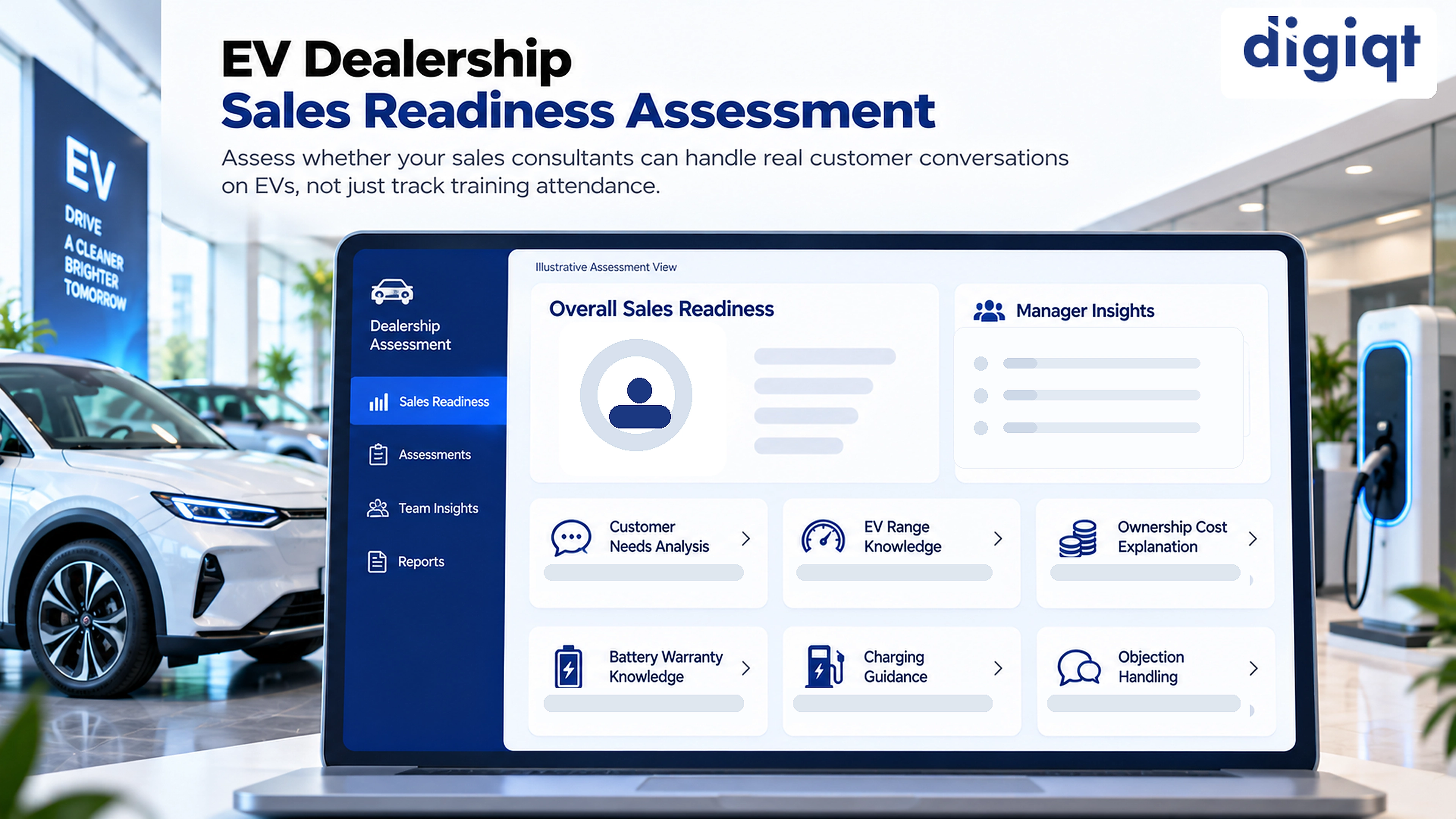
The principle behind this standard: EV readiness should be judged by how accurate a salesperson's ownership advice is, not just by how well they know the car.
How will you know which salespeople meet this standard and which ones don't?
Turn this readiness checklist into a score you can track across every dealership
How AI Sales Training for Automotive Dealerships Fits In
AI is already used across the automotive value chain, from manufacturing and predictive maintenance to dealership chatbots and in-car assistants. Sales training is one of the newer and more practical applications.
What is AI sales training for automotive dealerships?
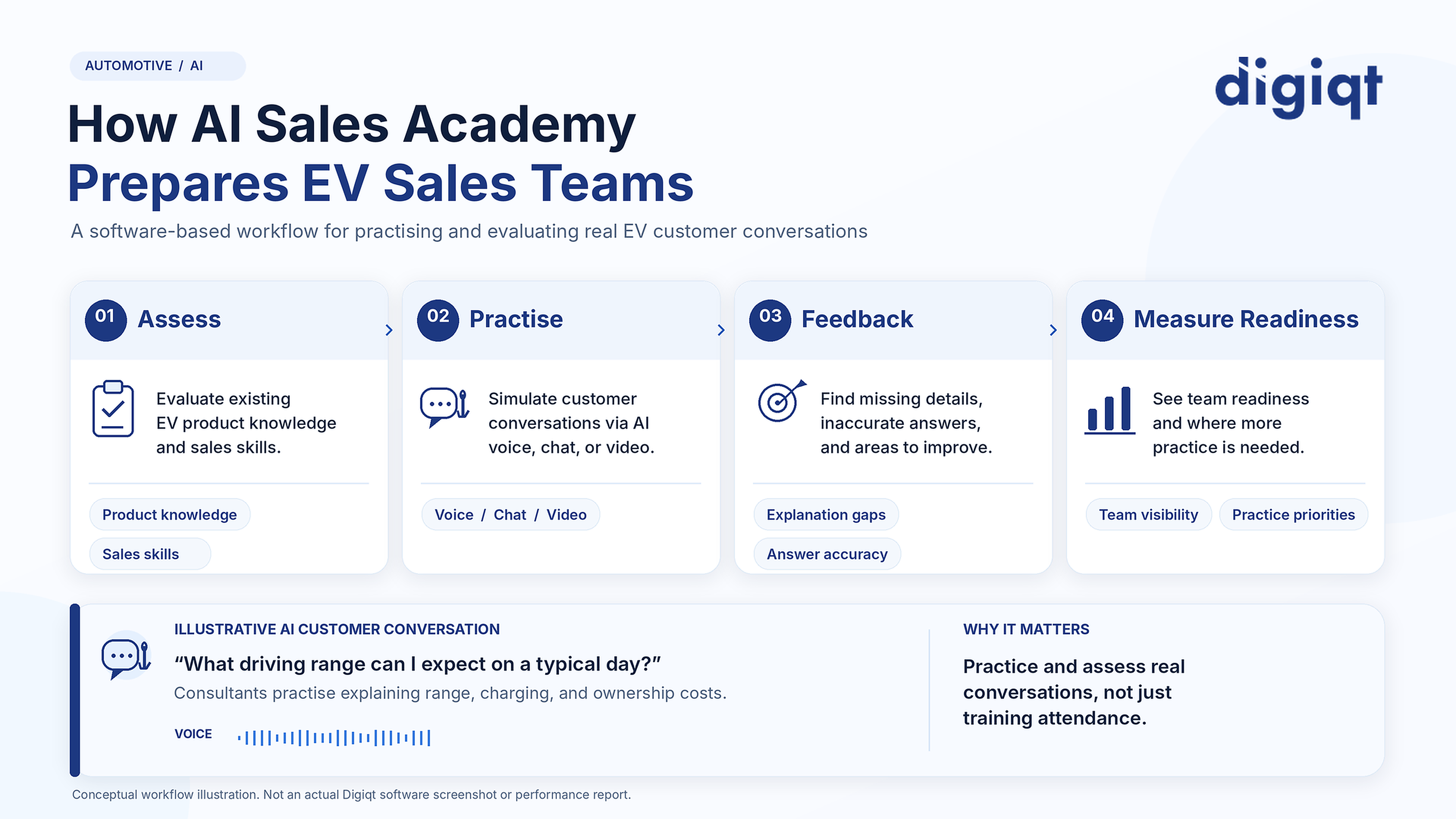
AI sales training for automotive dealerships uses AI to simulate realistic customer conversations. It then evaluates a salesperson's answers against approved product information and a scoring rubric, and gives feedback at scale. Unlike classroom sessions, it lets every salesperson practise difficult conversations repeatedly before they face a real customer.
AI sales roleplay for car dealerships: practise before the real customer
Practising conversations like Rahul's is hard to do at scale, and real customers should not be the first test.
Digiqt's AI Sales Academy for Automotive is built for this kind of preparation. It is designed to:
- evaluate vehicle knowledge and sales skills to find gaps,
- simulate realistic customer conversations through chat, voice, or video, including EV range and charging scenarios,
- give structured feedback on each conversation, and
- track readiness with a composite sales readiness score that managers can monitor.
Imagine a consultant practising Rahul's questions with an AI customer. To pass, they must do three things:
- explain why certified range differs from real-world driving,
- ask about charging access at his apartment, and
- calculate ownership costs without missing the battery fee.
When configured with the manufacturer's approved product information and evaluation criteria, this kind of AI sales simulation for dealerships can assess the consultant's answers. It can identify missing explanations and highlight what needs more practice before the next real customer. You can see the full assess, train, practise, and reassess cycle on the product page.
Inside AI Sales Academy: how we built the EV scenarios
When we designed the automotive version of AI Sales Academy, we built the EV scenarios around the questions buyers actually ask, not around the spec sheet. Each scenario starts with a customer line, tests specific skills, and has one clear training goal:
| What the AI customer says | Skills evaluated | Training goal |
|---|---|---|
| "Will I actually get the driving range advertised by the company?" | EV knowledge, communication, expectation management | Explain certified and real-world driving range |
| "I don't have home charging. Is an EV practical for me?" | EV knowledge, needs analysis, expectation management | Explain charging options based on the customer's situation |
| "The monthly EMI is higher than expected. Can you reduce it?" | Financing knowledge, negotiation, objection handling | Explain financing options and total repayment costs accurately |
Three design choices came directly from the problems described in this article:
- Approved content only. Question banks are generated from the manufacturer's own brochures, specifications, and training material, and an admin approves them before use. This guards against the incorrect incentive and range information seen in the Ashoka study.
- The whole conversation is scored. Evaluation covers discovery, pitching, objection handling, and closing, so a salesperson who quotes the right range without first asking about the customer's driving habits doesn't pass.
- No false commitments. Scenarios reward verified answers over confident promises, the same principle behind "know when to check rather than promise" in the charging section.
What to look for in automotive sales training software
If you are evaluating tools, check these five things:
- Grounding. Does it run on manufacturer-approved specifications, pricing, and warranty terms?
- Realism. Are conversations voice-based and realistic, and do they reflect how your customers actually speak?
- Scoring. Does it score against a readiness standard like the table above, not just course completion?
- Coaching quality. Is the AI sales coaching specific to each answer, rather than generic tips?
- Visibility. Can managers see readiness across salespeople and dealerships?
Where AI helps, and where it doesn't
AI supports practice and evaluation. It does not replace three things:
- manufacturer-approved information on range, charging, or warranties,
- coaching from experienced sales managers, and
- a salesperson's judgment to say "let me check that for you."
Disclosure: this article is published by Digiqt, which builds AI Sales Academy.
The Real Test for EV Sales Readiness
EV sales are accelerating, and manufacturers are investing in training. But Indian buyers still have real doubts about charging, range, and cost, and the showroom is where many of those doubts get answered.
The real test is not whether a salesperson attended EV training. It is this: would your customer discover the truth about their EV before buying it, or after?
Ready to see how your team handles the EV questions buyers actually ask?
Prepare your dealership teams for EV ownership conversations before the next customer walks in
Sources and Methodology
How this article was created. This article was researched and drafted with AI assistance, then reviewed and edited by the Digiqt team before publication. Every statistic was checked against the original or primary-reported source listed below on 23 October 2026, and figures that could not be verified were removed. The AI Sales Academy scenarios described are taken from the product as Digiqt built it.
What is and isn't real. Rahul is a hypothetical buyer used to illustrate common questions. Product prices, range figures, and warranty terms are as published by manufacturers and may change, so always confirm current terms with the manufacturer.
Sources:
- FADA, September 2026 EV retail data, via Autocar Professional
- Deloitte, 2026 Global Automotive Consumer Study: Key findings, Indian market (PDF)
- Ashoka University CSBC dealership study, summarised by a former CSBC researcher in India Development Review
- Hyundai Motor India press release on EV readiness and training
- Hyundai CRETA Electric pricing and battery warranty
- Hyundai press release on CRETA Electric Battery-as-a-Service
- Tata Motors, Punch.ev range and battery warranty
- Maruti Suzuki e-Vitara and Tata Punch.ev BaaS pricing, via Autocar Professional and Tata.ev
- Government of India, Lok Sabha written reply on public charging stations (21 July 2026), via Free Press Journal