AI Impact on Automotive Sales: 93% of Car Buyers Now Use AI

AI is changing how Indian car buyers compare vehicles, work out EMIs and plan their negotiations, long before they reach a showroom. That is the real AI impact on automotive sales: the customer walks in better prepared, and the salesperson has to be ready for what comes next.
This article covers three things:
- how buyers are using AI to research cars, based on new survey data
- where AI-informed buyers test a salesperson's readiness
- how dealerships can measure readiness instead of assuming it
Key takeaways
- 93% of 1,022 recent car buyers in Indian metros and Tier 1 cities used AI during active research (Google-Kantar, 2026).
- Buyers use AI to explore options, prioritise features, compare specifications, shortlist, and plan negotiations and EMIs.
- The showroom still matters. Buyers with seamless product discovery rated their purchase experience 872 out of 1,000, against 844 for others (J.D. Power).
- Completing product training is not the same as being ready. Dealerships need to measure each salesperson's ability to verify, compare and explain.
- AI roleplay is an emerging way to practise these conversations, with early research showing a modest average performance gain.
What Is the AI Impact on Automotive Sales?
The AI impact on automotive sales is a shift in where the sales conversation starts. Buyers now use AI tools to compare models, check features and estimate EMIs before visiting a dealership. Salespeople spend less time introducing products and more time validating what buyers found, correcting errors, understanding real needs and earning trust.
AI is also used inside the automotive business itself, from manufacturing to dealership chatbots and in-car assistants, and increasingly in voice agents for electric vehicles. This article focuses on the customer side: what changes when the buyer has already asked AI.
A Showroom Visit That Starts Halfway Through
This is an illustrative scenario.
Imagine a Saturday afternoon at a busy showroom:
- A couple walks in with their teenage son and a phone full of research.
- They have already compared two SUVs on safety ratings, mileage and monthly EMIs.
- The son asks which variant has the 360-degree camera. The mother asks why the on-road price is higher than an estimate they found online.
- The salesperson knows the brochure, but has never practised a conversation like this.
The family leaves to "think about it." Nothing the salesperson said was wrong. They just weren't ready for a buyer who arrived halfway through the decision.
How Are Indian Car Buyers Using AI to Research Cars?
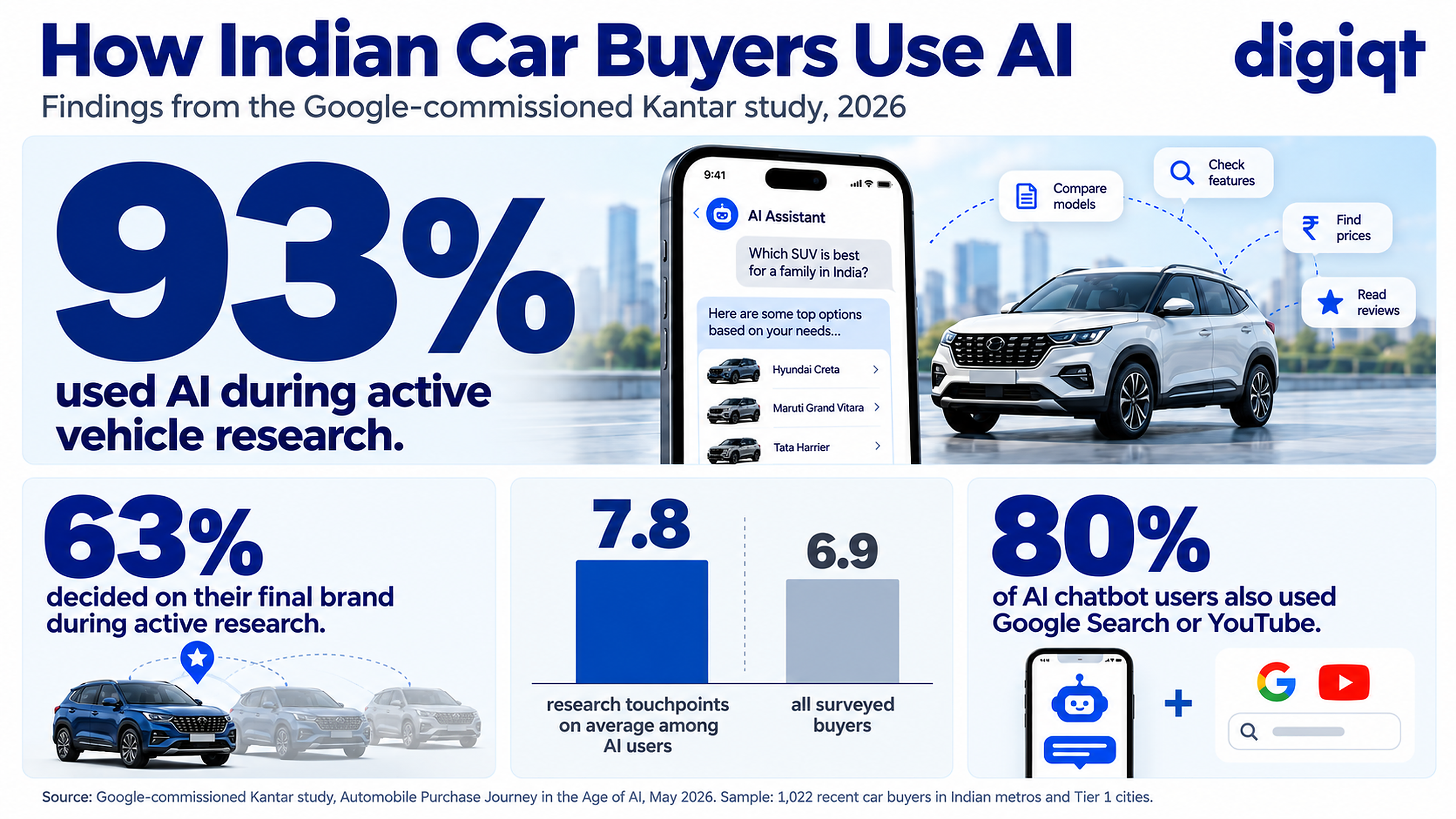
Most recent car buyers in urban India now use AI as part of their research. The Google-Kantar study Automobile Purchase Journey in the Age of AI surveyed 1,022 recent car buyers. All had bought a car in the previous six months and lived in Indian metros or Tier 1 cities. The study found:
- 93% used AI surfaces during active research. These include AI assistants such as Gemini and AI features in Google Search, such as AI Overviews and AI Mode.
- 63% decided on their final brand during active research, so the research phase is where many decisions are actually made.
- Buyers using AI averaged 7.8 research touchpoints, against 6.9 for buyers overall.
- 80% of buyers who used AI chatbots also used Google Search or YouTube, so AI adds to research rather than replacing it.
Buyers used AI for five tasks:
- exploring available options
- prioritising features and requirements
- comparing technical specifications
- creating a shortlist
- finalising negotiation strategy, financing and EMIs
Note: the study was commissioned by Google, which builds several of the AI tools it measured. Its findings are still among the most detailed available on Indian car buyers.
Informed buyers are not new. J.D. Power's 2022 India Sales Satisfaction Index Study found that 88% of shoppers researched online and more than 73% already knew the exact model they wanted. What has changed is how quickly buyers can now ask detailed, personalised follow-up questions and get an instant answer.
What Is Left for the Salesperson When Buyers Arrive Informed?
When buyers arrive informed, the salesperson's job shifts from presenting information to validating it, correcting what is wrong, reading real needs and earning trust. The evidence suggests this role matters more, not less:
- Product discovery drives satisfaction. In the same J.D. Power study, buyers with a seamless product discovery experience scored 872 out of 1,000, against 844 for those without. Yet 36% said their product discovery was not seamless.
- The sales consultant carries real weight. J.D. Power's 2023 study ranked the sales consultant as the most important factor in sales satisfaction, tied with working out the deal.
- The pre-purchase stage shapes the brand. In KPMG's India CX Report 2025, 50% of passenger vehicle customers said pre-purchase assessment most shapes their view of a brand. Sales staff support in assessing features was treated as a basic expectation.
- Good evaluation can lift the sale. 26% of the same customers said they would consider a higher-priced variant if they could evaluate and test-drive it first.
- Unmet expectations cost loyalty. 46% said they would switch to another brand if expectations on brand trust, vehicle performance and responsive support were not met.
Where Does AI-Informed Buying Test Sales Readiness?
AI-informed buyers test salespeople in four predictable places:
- Family decisions. In the Google-Kantar study, a partner or spouse influenced the final decision for 53% of buyers, and other family members for 64%. These groups overlap. The salesperson often has to answer several people with different priorities in one conversation.
- Specific feature questions. High safety ratings or advanced features, and superior styling, were the joint top differentiators, at 41% each.
- Imperfect AI answers. AI summaries can be incomplete or out of date. Salespeople need to correct them calmly, for example by checking whether a safety rating applies to the exact variant being quoted.
- Sharper price questions. Buyers who calculated EMIs online expect the on-road price to be explained line by line.
5 Questions Your Sales Team Will Face from AI-Informed Buyers
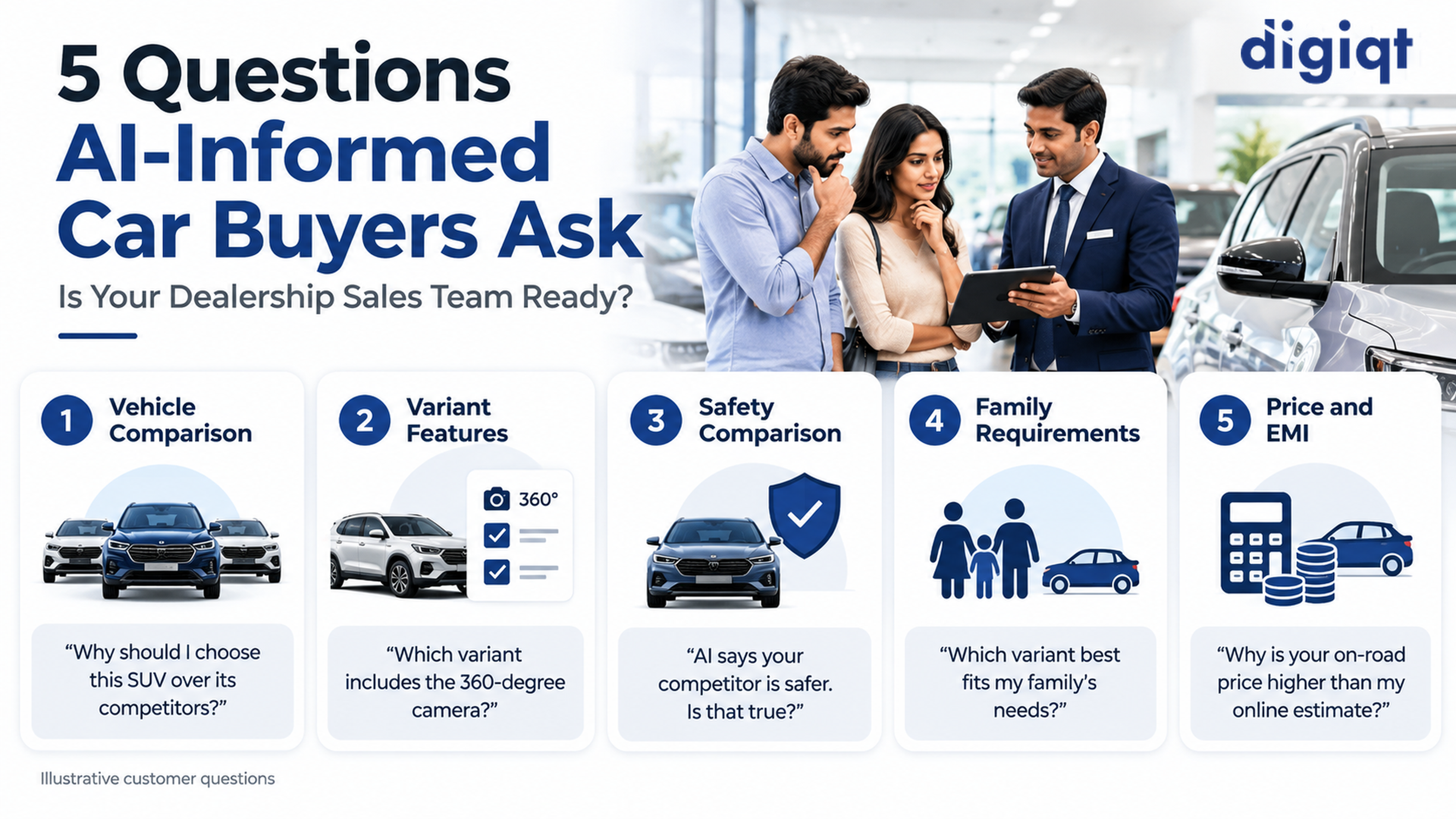
Each of the five AI research tasks produces a predictable showroom question. The questions below are illustrative.
| AI research task | What the buyer asks | What a ready answer needs |
|---|---|---|
| Exploring options | "AI suggested three other SUVs in my budget. Why this one?" | Honest positioning, not dismissal of rivals |
| Prioritising features | "My son wants the 360-degree camera. Which variant actually has it?" | Accurate variant-level knowledge |
| Comparing specifications | "AI says your competitor is safer." | A comparison checked against the official rating for that variant |
| Shortlisting | "I know the features. Which variant fits my family?" | Needs discovery before any pitch |
| Negotiation and EMIs | "An online estimate was cheaper, and another dealer offers more discount." | A transparent on-road price breakdown, not an instant discount |
The test is not memorising perfect answers. It is asking the right questions, verifying information and helping the customer reach a decision that fits.
Take the safety question. These responses are illustrative.
- Memorised answer: "Our car also has excellent safety features. It has six airbags and advanced technology."
- Ready answer: "Which safety features matter most to you? Let's compare the official ratings and the equipment in both variants, and I can show you those features on this car."
Both salespeople may have completed the same training. The question is whether a dealership can spot the difference before a real customer walks in.
Could every salesperson on your floor handle "AI says your competitor is safer"?
Find out which salespeople are ready for AI-informed buyers before your customers do
How Do Dealerships Train Salespeople Today?
Indian dealerships already train their salespeople through manufacturer programmes, and dealers value that support. Two recent examples show the scale:
- In FADA's 2026 Dealer Satisfaction Study, based on 2,045 dealer responses, dealers cited sales-team training among the OEM support they appreciate. Training cost-sharing remained one of their concerns.
- Hyundai Motor India says it has trained more than 10,000 sales personnel for EV sales alone.
The open question is not whether training happens. It is how consistently practice is repeated, personalised and measured for each salesperson as models, offers and competitor claims change.
Why Is Training Completion Not the Same as Sales Readiness?
Training completion shows that a salesperson attended. Readiness shows they can handle a real conversation. Three gaps separate them:
- Knowing is not explaining. A feature list does not show how to make that feature matter to one particular family.
- One assessment is a snapshot. Passing at a model launch does not show how someone handles a new rival claim six months later.
- Managers often can't see the gap. Without regular assessment, weaknesses may only show up in front of real customers.
How Can Dealerships Measure Real Sales Readiness?
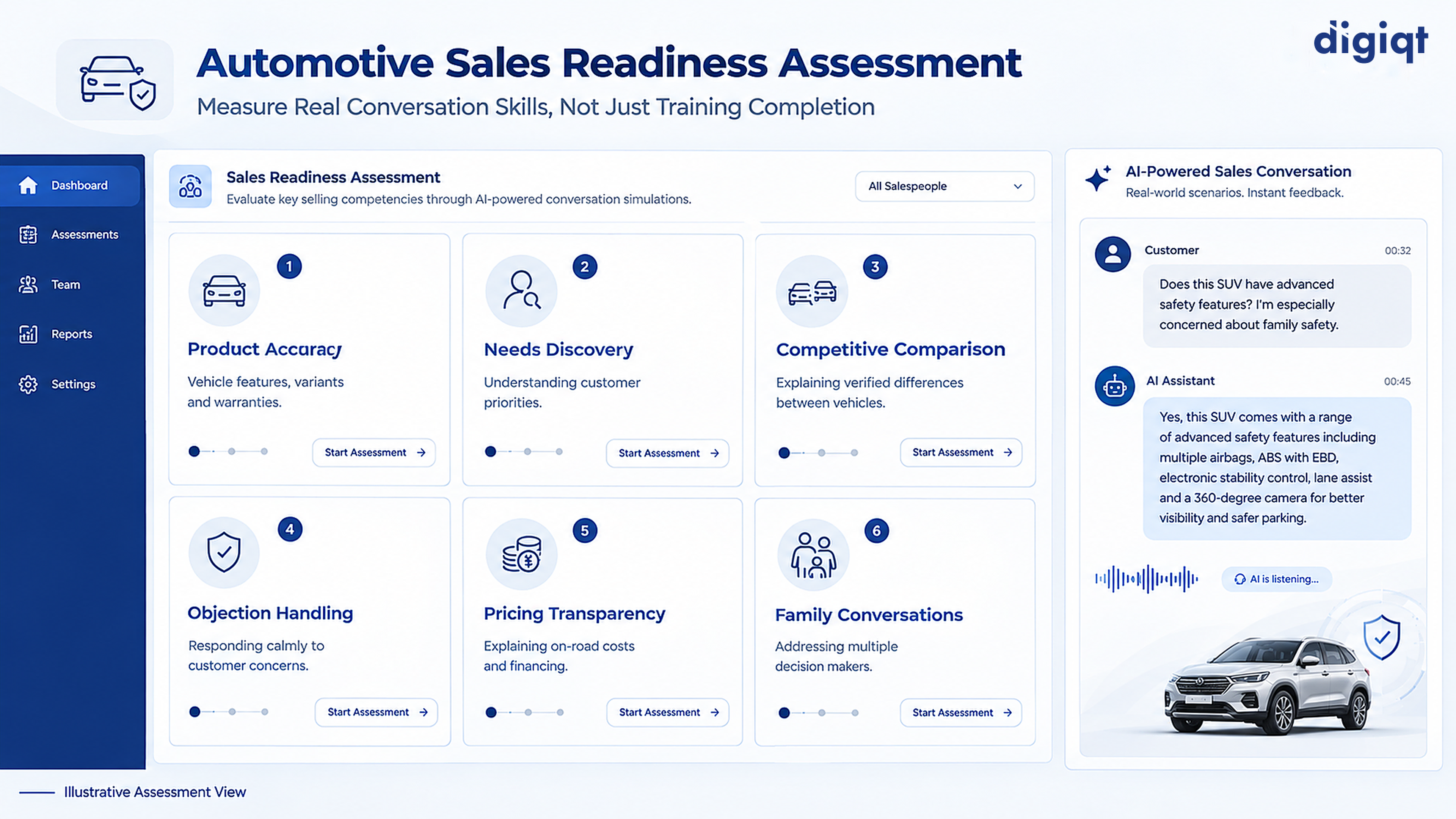
A useful sales readiness assessment tests what salespeople do in a conversation, not what they recall in a quiz. It should cover six areas:
| Area | What a ready salesperson does | Red flag |
|---|---|---|
| Product accuracy | States features, variants and warranties correctly | Guesses which variant has a feature |
| Needs discovery | Asks about usage, family and priorities before pitching | Starts with a feature list |
| Competitive comparison | Compares rival models fairly, using official sources | Dismisses the competitor or the customer's research |
| Objection handling | Stays calm and specific when challenged | Gets defensive or vague |
| Pricing transparency | Explains every line of the on-road price | Jumps straight to a discount |
| Family conversations | Addresses each decision maker's concerns | Talks only to one person |
How would you know which salespeople meet this standard today?
Turn these six readiness areas into a score you can track across every showroom
How Should Dealerships Measure the Business Impact?
Set a baseline first, then test whether focused practice is associated with better results. Useful measures include:
- enquiry-to-booking conversion
- the number of unresolved objections and reliance on discounts to close
- consistency of customer experience across branches
Treat early results as signals, not proof. Many factors affect conversion, so compare similar teams and periods before drawing conclusions.
Can AI Help Salespeople Practise Before Meeting Real Buyers?
Yes, and early research supports it, with realistic expectations. Knowing who struggles with comparisons or pricing objections is only the first step. The harder part is improving before the next real showroom conversation.
What the research says
A working paper by Habel, Ahearne and colleagues studied almost 2,000 salespeople at a large US firm, some of whom trained with AI role plays. It found:
- an average performance improvement of about 2%
- much larger gains, from 7% to 35%, for some groups, including salespeople with low prior performance and those with high-performing supervisors
The study is not specific to Indian car dealerships and has not yet been peer reviewed. Its authors also stress the need to manage how practice transfers into real selling. It is early, but credible, evidence that realistic practice can help.
How AI Sales Academy turns skill gaps into practice
Digiqt's AI Sales Academy for Automotive follows an assess, train, practise and reassess cycle. Here is how it works for a salesperson who knows an SUV's specifications but struggles when customers compare it with a rival. This example is illustrative.
- Assess. The platform tests their vehicle knowledge and spots the weakness in competitor comparisons.
- Train. It assigns personalised learning focused on that gap.
- Practise. In chat, voice or video roleplay scenarios, an AI buyer who has researched three SUVs asks about safety ratings, variant differences and the on-road price.
- Reassess. Each conversation is evaluated, with clear fixes and another round of practice.
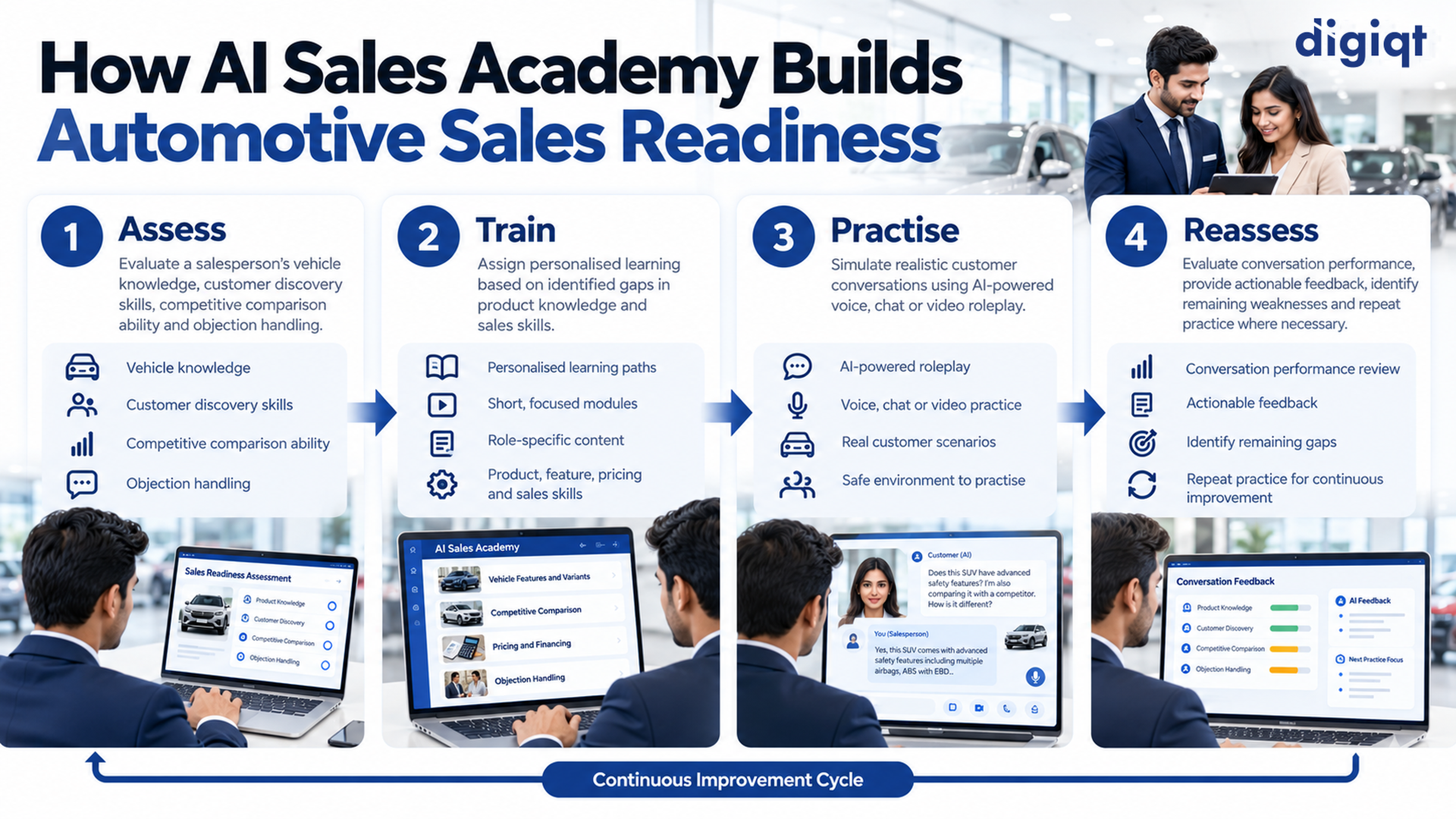
Managers can see who needs coaching in vehicle knowledge, customer discovery, competitor comparisons or negotiation, and track a sales readiness score across showrooms.
The scenarios we built for AI-informed buyers
When we built the automotive version of AI Sales Academy, we designed its practice scenarios around the conversations that actually happen in showrooms. Five of them map directly to the questions AI-informed buyers bring:
| What the buyer researched with AI | What the AI customer says | Skills evaluated | Training goal |
|---|---|---|---|
| Comparing options | "Another brand offers a similar SUV at a lower price. Why should I choose yours?" | Product comparison, value explanation, objection handling | Explain verified differences based on customer needs |
| Prioritising features | "Why should I pay extra for the higher variant?" | Variant comparison, needs discovery, value explanation | Match additional features with actual buyer needs |
| Comparing specifications | "Can advanced driver assistance features prevent accidents?" | Safety knowledge, communication, expectation management | Explain feature capabilities and limitations accurately |
| Negotiation and EMIs | "The monthly EMI is higher than expected. Can you reduce it?" | Financing knowledge, negotiation, objection handling | Explain financing options and total repayment costs accurately |
| Shortlisting | "I liked the car, but I want to compare other models." | Listening, follow-up, objection handling | Address concerns and agree on the next step |
Three design choices came directly from the problems described in this article:
- Approved content only. Assessments are generated from the dealership's or manufacturer's own brochures, specifications and product comparisons, and an admin approves them before use. Salespeople practise against verified information, not the same incomplete claims a buyer may have read.
- The whole conversation is scored. Evaluation covers discovery, pitching, objection handling and closing. A salesperson who quotes the right specification without first asking what the family needs doesn't pass.
- Accuracy over promises. Scenarios such as the safety question above, or a buyer asking "Can you guarantee delivery before the festival?", reward honest, verified answers over confident commitments.
Where AI helps, and where it doesn't
AI supports practice and evaluation. It does not replace three things:
- manufacturer training and approved product information,
- coaching from experienced sales managers, and
- a salesperson's judgment in front of a real family.
Disclosure: this article is published by Digiqt, which builds AI Sales Academy.
The Real Test for Dealerships
Buyers have changed how they prepare. The AI impact on automotive sales is not that the salesperson matters less. It is that the salesperson is tested harder, on accuracy, honesty and listening.
So the question for every dealership is this: if a family walks in tomorrow with an AI comparison, which of your salespeople would you trust to have that conversation?
Is your team ready for buyers who have already asked AI?
Give every salesperson realistic practice before the next informed family walks in
Sources and Methodology
How this article was created. This article was researched and drafted with AI assistance, then reviewed and edited by the Digiqt team before publication. Every statistic was checked against the original or primary-reported source listed below on 23 October 2026, and figures that could not be verified were removed. The AI Sales Academy workflow and scenarios are taken from the product as Digiqt built it.
What is and isn't real. The opening showroom scenario, the five buyer questions table and the sample answers are illustrative. The AI Sales Academy scenarios are real product scenarios. All statistics come from the published sources below.
FAQs
What is the AI impact on automotive sales?
- AI is changing how buyers prepare before they visit a showroom. In a Google-commissioned Kantar study, 93% of recent Indian car buyers used AI during research. Buyers now arrive with comparisons, EMI estimates and negotiation plans, so salespeople spend less time introducing products and more time validating information, correcting errors and building trust.
How many Indian car buyers use AI to research cars?
- 93% of surveyed buyers used AI surfaces during active research, according to the Google-Kantar study Automobile Purchase Journey in the Age of AI. The study surveyed 1,022 people in Indian metros and Tier 1 cities who had bought a car in the previous six months, with fieldwork in May 2026.
What do car buyers use AI for during research?
- Buyers use AI for five main tasks: exploring available options, prioritising features, comparing technical specifications, building a shortlist, and finalising purchase details such as negotiation strategy, financing and EMIs. Each task produces a predictable showroom question, so salespeople should be ready for detailed comparisons and price breakdowns.
Does AI replace the car salesperson?
- No. Research shows the showroom still shapes the decision. J.D. Power found buyers with seamless, consultant-led product discovery scored 872 out of 1,000 for sales satisfaction, against 844 for others. KPMG found 50% of passenger vehicle customers say the pre-purchase stage most shapes their view of a brand.
How should a salesperson respond when a customer's AI answer is wrong?
- Stay calm, ask what the customer read, and verify it together against official sources, such as the safety rating and equipment for the exact variant being compared. Dismissing the research damages trust. Checking it openly builds trust.
How can dealerships prepare salespeople for AI-informed buyers?
- Move from one-time training to repeated, measured practice. Assess each salesperson on product accuracy, needs discovery, competitive comparison, objection handling, pricing transparency and family conversations, then give targeted practice on the gaps before they meet real customers.
Does AI roleplay training improve sales performance?
Early evidence is positive but modest. A working paper by Habel and colleagues, covering almost 2,000 salespeople, found AI role plays were associated with about a 2% average performance improvement, with larger gains for some groups, including lower prior performers. The study was not specific to car dealerships.
What should a dealership sales readiness assessment cover?"
- It should cover six areas: product accuracy across features, variants and warranties; needs discovery before pitching; fair competitive comparison; calm objection handling; transparent on-road pricing; and handling several family decision makers in one conversation. Test these through realistic conversations rather than quizzes, and repeat the assessment as models and offers change."
Sources:
- Google and Kantar, Automobile Purchase Journey in the Age of AI (May 2026), via Autocar Professional
- J.D. Power 2022 India Sales Satisfaction Index Study
- J.D. Power 2023 India Sales Satisfaction Index Study
- KPMG in India, India CX Report 2025: Passenger vehicles
- FADA Dealer Satisfaction Study 2026, via Autocar India
- Hyundai Motor India press release on EV readiness and training
- Habel, Ahearne, Tirunillai and Vandaveer Novak, Do AI Role Plays Improve Sales Performance? (SSRN working paper)