5 AI Agents in Port Operations (2026)
How AI Agents Are Transforming Port Operations for Terminal Operators in 2026
Maritime transport moves over 80% of goods traded worldwide by volume, according to UNCTAD. Small delays in berth planning, yard operations, gate flow, equipment availability, or documentation can therefore affect terminal throughput.
AI agents help port teams combine operational data, detect conflicts, recommend actions, and automate approved low-risk workflows. This article covers five practical use cases, required data, human-control boundaries, implementation, and ROI.
Where Do AI Agents Fit in Port Operations?
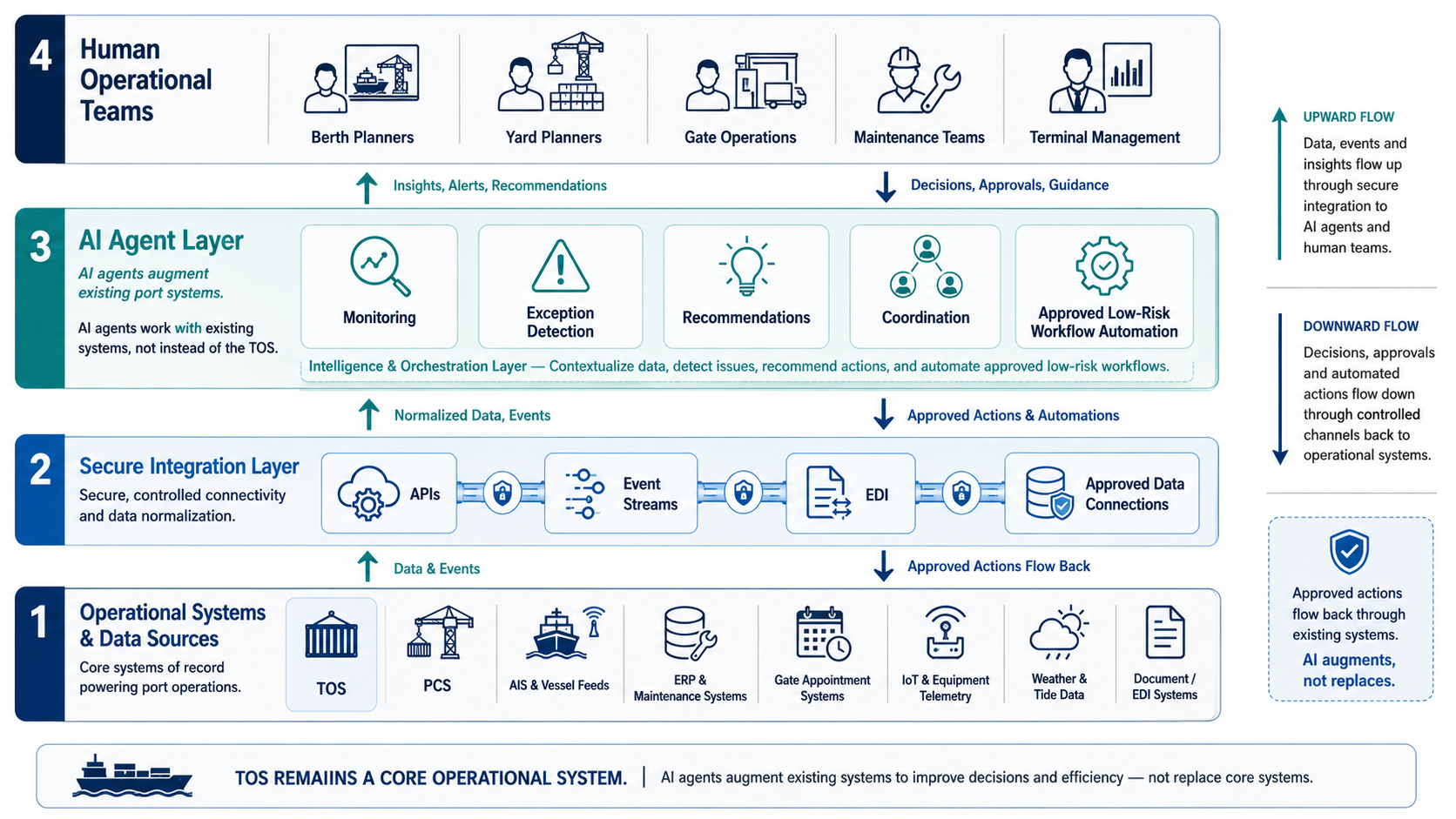
AI agents usually sit above existing port systems rather than replacing them.
TOS, PCS, AIS, ERP, gate systems, IoT, weather and EDI data
→ secure integration layer
→ AI agent
→ approved action or human decision
The TOS remains the system of record, while the AI agent coordinates data, exceptions, and workflows across systems. Similar cross-system orchestration is covered in Digiqt's AI Agents in Supply Chain Management.
What Are 5 Practical AI Agent Use Cases in Port Operations?
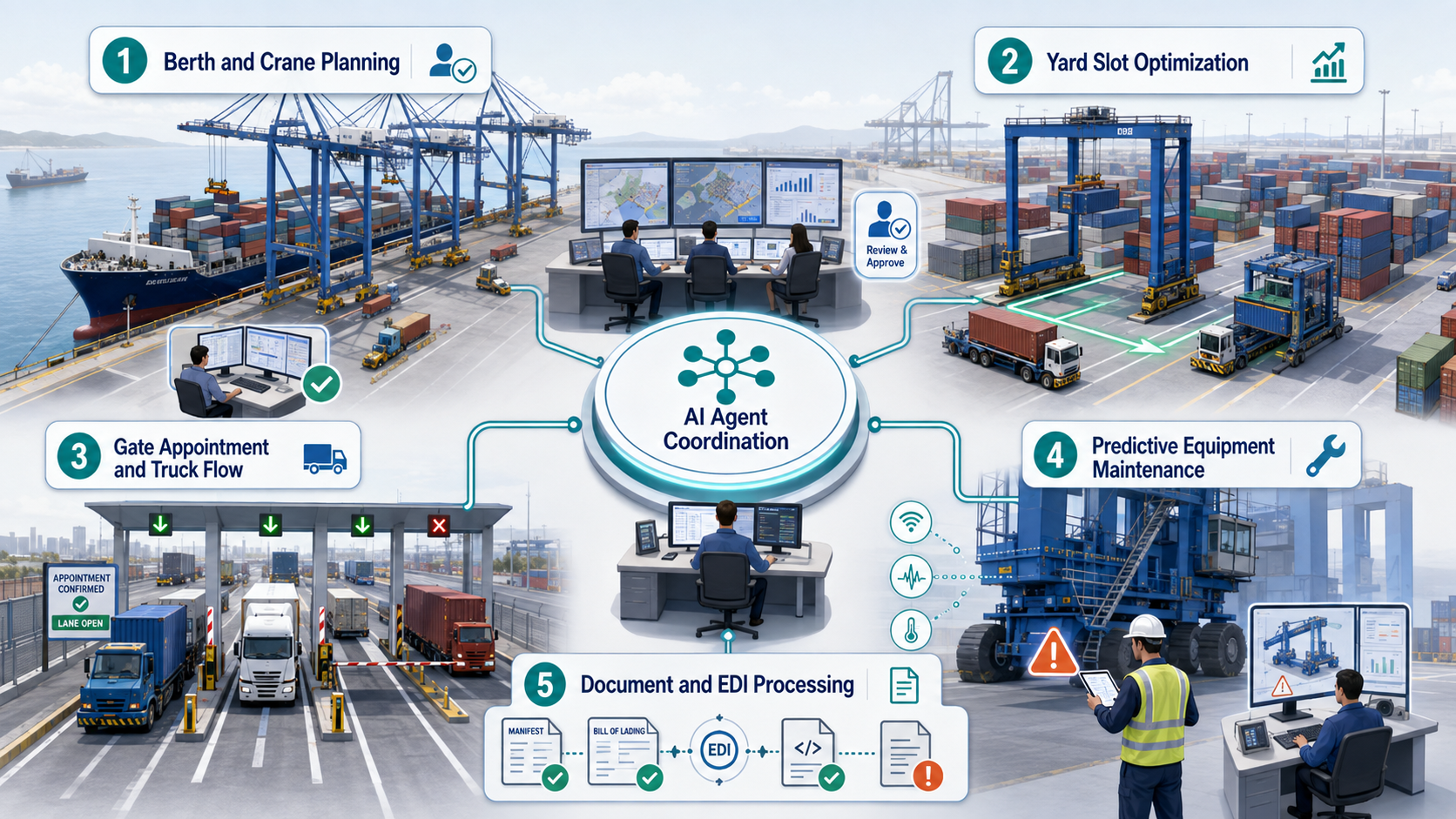
The five practical use cases are berth and crane planning, yard slot optimization, gate orchestration, predictive equipment maintenance, and document or EDI processing.
1. How Can AI Agents Improve Berth and Crane Planning?
AI agents can improve berth and crane planning by combining vessel, berth, crane, tide, and yard data to identify conflicts and recommend revised operating plans.
A berth-planning agent can use vessel ETA, AIS position, draft restrictions, tide windows, berth availability, crane availability, and yard capacity.
If a vessel is delayed, the agent can identify conflicts and present revised options to the berth planner for review.
2. How Can AI Agents Optimize Yard Slot Allocation?
AI agents can optimize yard slots by using container status, dwell time, pickup forecasts, yard occupancy, and equipment availability to reduce avoidable rehandles.
The agent can recommend better stacking locations as vessel plans, pickup expectations, and yard conditions change. Related yard and dock coordination patterns are explored in AI Agents in Yard Management for Warehousing.
3. How Can AI Agents Improve Gate Appointments and Truck Flow?
AI agents can improve gate flow by matching truck appointments with container readiness, yard conditions, and available terminal capacity before congestion develops.
The agent can flag at-risk pickups and recommend approved slot changes or notifications when the yard cannot serve scheduled demand. Digiqt's AI Agents in Fleet & Dock Management for Warehousing covers similar appointment, queue, and dock-flow coordination.
4. How Can AI Agents Support Predictive Equipment Maintenance?
AI agents can support predictive maintenance by monitoring equipment telemetry and maintenance history to identify emerging risks before they disrupt terminal operations.
The agent can alert engineering teams when unusual patterns appear, while critical equipment actions remain under human control. For a deeper look at asset-health workflows, see AI Agents in Predictive Maintenance.
5. How Can AI Agents Automate Document and EDI Processing?
AI agents can automate document and EDI workflows by extracting shipment data, validating it against port systems, identifying mismatches, and routing exceptions for review.
Typical inputs include manifests, bills of lading, EDI messages, invoices, customs records, and booking data. For adjacent trade-document and compliance workflows, see AI Agents in Customs Clearance.
What Data Do Port AI Agents Need?
Port AI agents typically need operational data from TOS, AIS, yard, gate, equipment, ERP, maintenance, weather, tide, EDI, or document systems, depending on the workflow.
| AI Agent | Core Data Inputs |
|---|---|
| Berth and crane planning | AIS/ETA, vessel data, berth and crane availability, tide, yard capacity |
| Yard optimization | Container status, dwell time, discharge plan, pickup forecast, yard occupancy |
| Gate orchestration | Appointments, container readiness, yard status, gate capacity |
| Predictive maintenance | Sensor telemetry, fault history, work orders, operating hours |
| Document processing | Manifests, B/L, EDI, booking data, invoices, reference data |
The port does not need to connect every system before starting. A focused pilot should connect only the minimum reliable data required for one measurable workflow.
How Are AI Agents Different From a TOS?
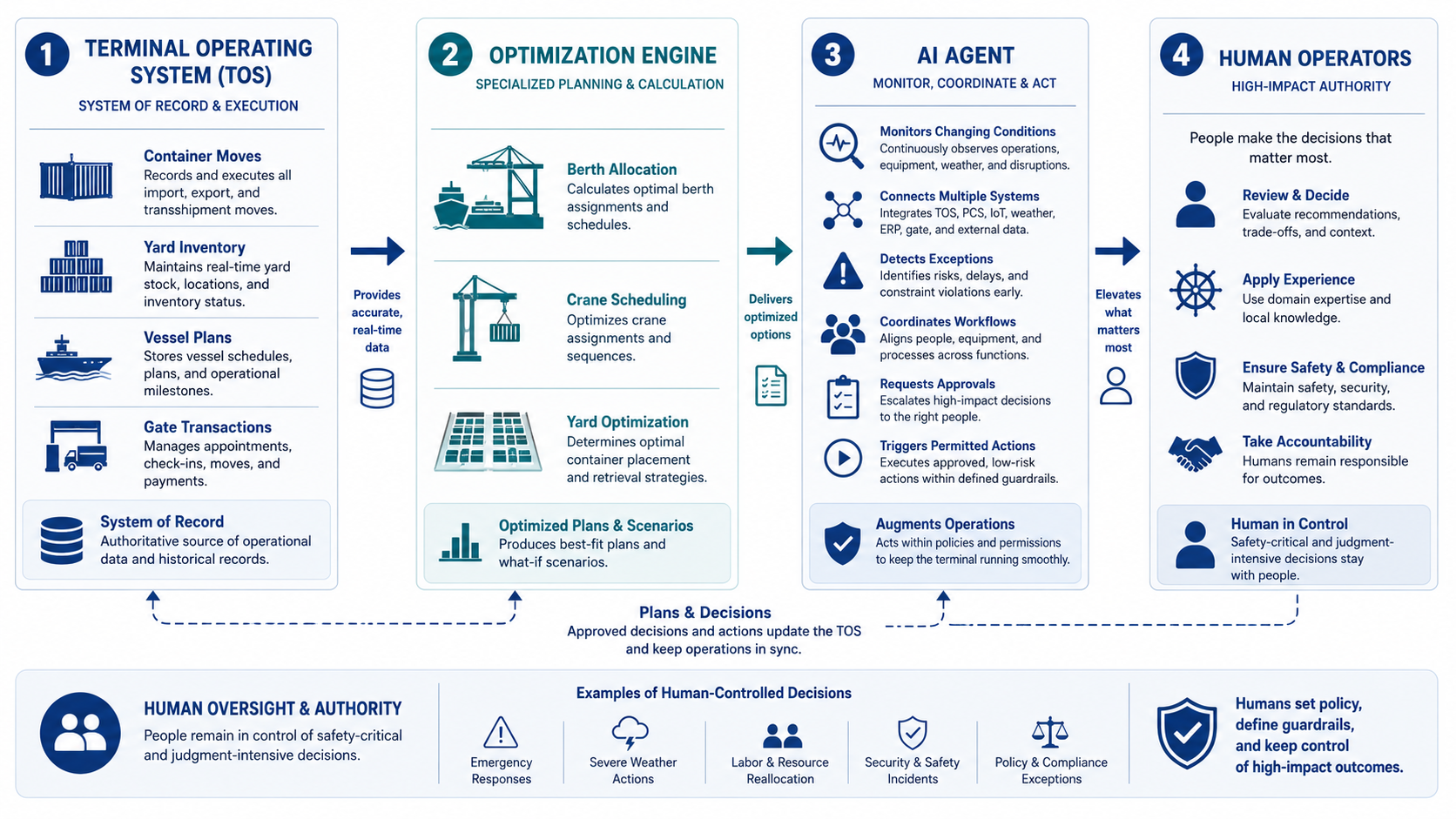
A TOS records and executes terminal operations, while an AI agent connects data across systems, detects changing conditions, coordinates exceptions, and supports approved decisions.
| TOS | Optimization Engine | AI Agent |
|---|---|---|
| Runs and records terminal operations | Solves a defined planning problem | Coordinates decisions across systems |
| Stores operational records | Produces optimized plans | Detects changes and exceptions |
| Executes configured workflows | Recalculates when inputs change | Requests approvals or triggers approved actions |
A simple model is:
TOS stores and executes → optimization calculates → AI agent coordinates → humans retain high-impact authority
What Can AI Automate, and What Needs Human Approval?
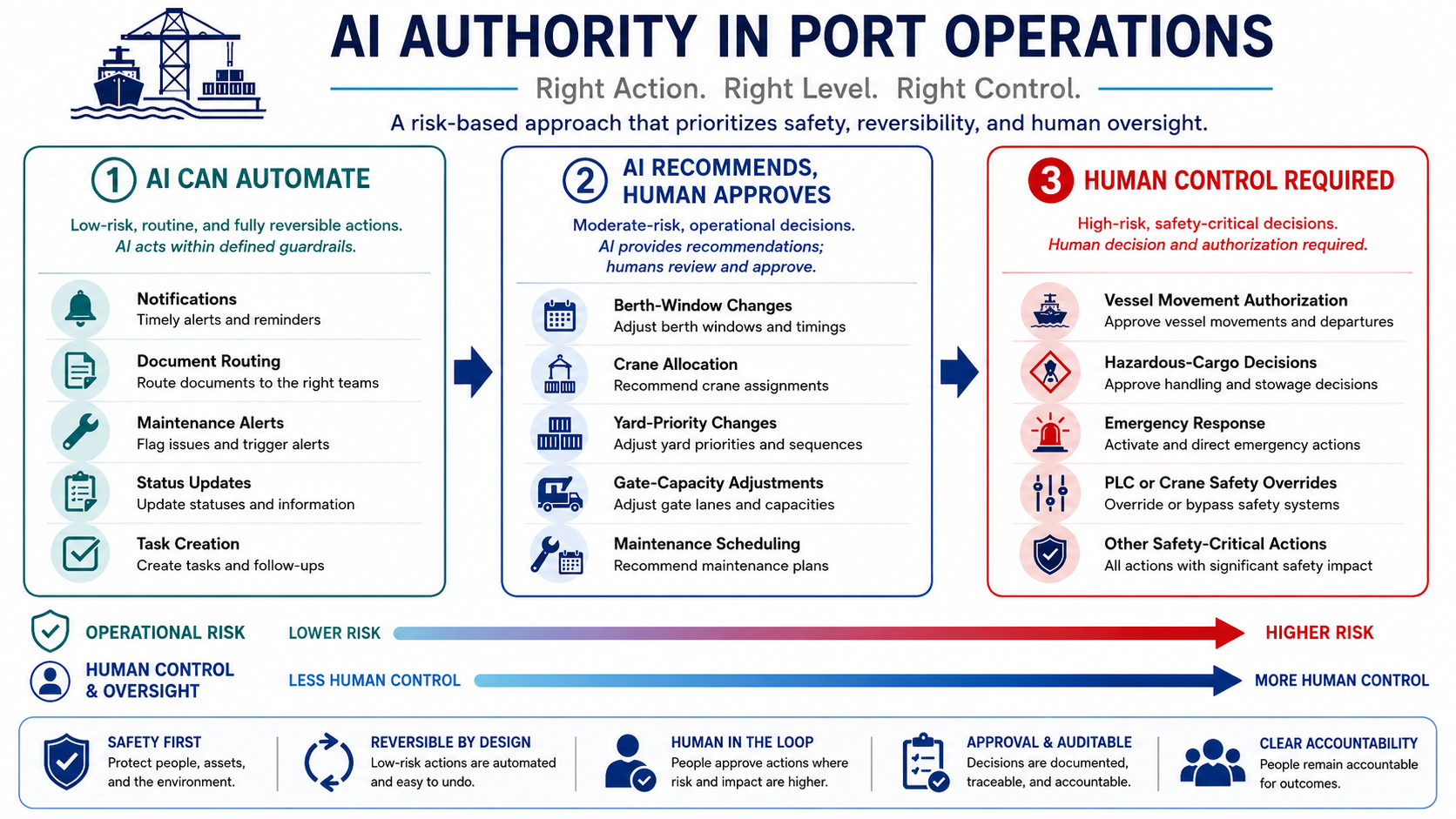
AI can automate low-risk, reversible workflows; material operational decisions should require human approval; and safety-critical actions should remain under direct human control.
AI can automate low-risk work, such as:
- notifications
- document routing
- maintenance alerts
- task creation
- routine status updates
AI can recommend, but humans should approve:
- berth-window changes
- crane reallocation
- yard-priority changes
- gate-capacity adjustments
- maintenance scheduling
Human control should remain mandatory for:
- vessel movement authorization
- hazardous-cargo decisions
- emergency actions
- PLC or crane safety overrides
- other safety-critical operations
Which AI Agent Should a Terminal Deploy First?
A terminal should start with the AI agent tied to its clearest measurable bottleneck, where the required data is accessible and the workflow can be piloted safely.
| Main Problem | Best First Agent |
|---|---|
| Vessel delays or frequent replanning | Berth and Crane Planning |
| High rehandles or yard congestion | Yard Slot Optimization |
| Long truck queues | Gate Orchestration |
| Equipment downtime | Predictive Maintenance |
| Heavy manual document work | Document Processing |
A good first pilot needs a clear owner, measurable KPI, accessible data, and limited safety risk.
How Does Digiqt Implement Port AI Agents?
Digiqt starts with one measurable port bottleneck, connects the minimum required systems, validates recommendations in shadow mode, and automates approved low-risk workflows only after validation.
1. How Does Digiqt Establish the Operational Baseline?
Digiqt establishes the baseline by measuring the KPI tied to the selected bottleneck before the AI-agent pilot begins.
This may include vessel waiting time, rehandles, truck turn time, equipment downtime, or document-processing effort.
2. How Does Digiqt Connect the Required Port Systems?
Digiqt connects only the systems and data required for the selected workflow, keeping the initial integration scope focused and measurable.
Depending on the use case, this may include TOS, PCS, AIS, gate, IoT, ERP, maintenance, or document systems. The same integration-first approach is relevant across multi-party logistics workflows such as those covered in AI Agents in Freight Forwarding.
3. How Does Shadow Mode Validate a Port AI Agent?
Shadow mode validates an AI agent by letting it use live operational data and generate recommendations without executing changes.
Port teams can compare those recommendations with real planner decisions before granting the agent wider permissions.
4. When Should Port AI Workflows Move Into Controlled Automation?
Port AI workflows should move into controlled automation only after recommendations are reliable, approval rules are defined, and low-risk actions have been validated.
Higher-impact and safety-critical decisions should continue to require human review or direct human control.
Have a specific port bottleneck in mind? Digiqt can help define the use case, data requirements, approval model, and pilot scope.
How Should Terminal Operators Measure ROI?
Terminal operators should measure ROI by comparing pre- and post-deployment KPIs, converting verified operational improvements into financial or capacity value, and subtracting total AI-agent costs.
| Use Case | What to Measure |
|---|---|
| Berth planning | Vessel waiting time, berth time, planning disruptions |
| Yard optimization | Rehandles, dwell time, equipment travel |
| Gate orchestration | Truck turn time, queue time, failed pickups |
| Predictive maintenance | Unplanned downtime, asset availability |
| Document processing | Processing time, manual effort, exception volume |
A practical model is:
Baseline → measured improvement → financial or capacity value → AI-agent cost → ROI
The cost side should include implementation, integration, infrastructure, model usage, security, testing, training, and ongoing maintenance.
How Should Ports Handle Cybersecurity and AI Failure?
Ports should isolate AI from safety-critical OT, apply least-privilege access and secure integrations, require human approval for high-impact actions, and maintain fallback processes when AI or data fails.
Recommended controls include:
- IT/OT network segmentation
- least-privilege access
- secure APIs and integration layers
- human approval for high-impact actions
- audit logs
- stale-data and confidence checks
- manual override
- fallback to existing TOS or manual workflows
If data or recommendations become unreliable, the workflow should stop, escalate, or fall back to the existing process.
Relevant references include the IMO Guidelines on Maritime Cyber Risk Management, NIST SP 800-82 Rev. 3, and IEC 62443.
Is Your Port Ready for an AI-Agent Pilot?
A port is ready for an AI-agent pilot when it has a defined operational problem, measurable baseline, accessible data, feasible integrations, a clear owner, and agreed human-approval boundaries.
A terminal is a strong candidate when it can answer yes to most of these:
- Is there a clearly defined operational bottleneck?
- Can we measure the current baseline?
- Is the required data accessible?
- Can the relevant systems be integrated securely?
- Is there a clear operational owner?
- Are human approval boundaries defined?
- Can the workflow begin in shadow or recommendation mode?
- Do we know what KPI must improve?
If several answers are no, the next step may be data or integration readiness rather than immediate AI deployment.
Conclusion
AI agents create the most value when they address a specific operational problem, use reliable data, integrate with existing systems, and operate within clear human-control boundaries.
The best starting point is usually the use case that can be measured, validated, and proven before wider automation.
Want to evaluate where AI agents could fit in your terminal?
Frequently Asked Questions
1. What are AI agents in port operations?
AI agents use port data, business rules, and connected systems to support decisions, coordinate workflows, and automate approved low-risk tasks.
2. Do AI agents replace a Terminal Operating System (TOS)?
No. The TOS remains the core operational system. AI agents typically sit above it to combine data, detect changes, coordinate exceptions, and support decisions.
3. Which port AI agent should a terminal deploy first?
Start with the agent connected to the terminal's clearest measurable bottleneck, such as vessel delays, yard congestion, truck queues, equipment downtime, or document processing.
4. What data do port AI agents need?
Depending on the use case, they may need TOS, AIS, yard, gate, equipment telemetry, ERP, maintenance, weather, tide, EDI, or document data.
5. Can port AI agents make decisions automatically?
Only within approved limits. Low-risk workflows may be automated, while material operational decisions should require human approval and safety-critical actions should remain human-controlled.
6. How can a port test an AI agent safely?
Higher-impact agents can begin in shadow mode, where they use live data and generate recommendations without executing operational changes.
7. How should terminals measure AI-agent ROI?
Compare pre- and post-deployment KPIs, then convert verified improvements in vessel time, rehandles, truck flow, downtime, or processing effort into terminal-specific value.
8. How should ports secure AI agents?
Use network segmentation, least-privilege access, secure integrations, audit logs, approval controls, and fallback processes while keeping AI away from direct safety-critical OT control.