Event Demand Forecasting AI Agent for Event Management in Hospitality
Discover how an Event Demand Forecasting AI Agent boosts hospitality event management via precise demand prediction, pricing and staffing.
What is an Event Demand Forecasting AI Agent in Hospitality?
An Event Demand Forecasting AI Agent helps hotels and hospitality businesses predict demand for meetings, conferences, weddings, banquets, exhibitions, and other events. It analyzes historical bookings, RFP activity, event calendars, customer behavior, pricing, and operational data to forecast future inquiries, bookings, attendance, cancellations, revenue, and function-space demand.
The AI agent then turns these forecasts into practical recommendations for event pricing, space allocation, staffing, procurement, and sales prioritization. This helps hotel revenue, sales, and operations teams make earlier and more informed decisions instead of relying only on historical averages or manual forecasting.
How does Event Demand Forecasting AI support hotel teams?
In simple terms, an Event Demand Forecasting AI Agent predicts what type of event demand a hotel may receive, when that demand is likely to occur, how many attendees may be expected, and what revenue and operational requirements those events could create.
For example, if corporate meeting demand is expected to increase during a particular week, the AI agent can help hotel teams decide how to price function space, how many staff members may be needed, how much food and beverage inventory to prepare, and which event inquiries should receive priority.
What does the AI agent forecast?
The AI agent can forecast RFP volume, booking conversion, function-space demand, room-night pickup, ancillary revenue, cancellations, attrition, and seasonal event demand.
AI event forecasting can analyze and predict several areas of hotel event demand, including:
- Event lead volume from Requests for Proposals (RFPs), direct inquiries, and repeat group business
- Conversion likelihood across corporate, association, social, wedding, and other event segments
- Function-space demand across ballrooms, breakout rooms, outdoor spaces, and different time slots
- Group room-night pickup and expected wash or attrition
- Food and Beverage (F&B), audiovisual, spa, parking, and other ancillary revenue connected with events
- No-show, cancellation, and attrition risk
- Seasonal demand and compression caused by conventions, citywide events, holidays, and local calendars
Who uses AI event demand forecasting?
Revenue, sales, operations, procurement, and hotel leadership teams can use AI event demand forecasts to support pricing, planning, staffing, and resource decisions.
Hotel event demand forecasts can support several teams:
- Revenue leaders use forecasts to guide event pricing, minimum spends, and group displacement decisions.
- Sales teams use demand and conversion signals to prioritize RFPs and focus on higher-value opportunities.
- Banquet, F&B, housekeeping, engineering, and other operations teams use forecasts to allocate staff and resources.
- Procurement teams use expected attendance and event schedules to improve purchasing and reduce unnecessary inventory.
- General managers and senior leadership can use portfolio-level forecasts for planning, benchmarking, and investment decisions.
Where does it fit within the hotel technology stack?
AI event demand forecasting typically operates alongside a hotel's Property Management System (PMS), Sales and Catering (S&C) platform, Revenue Management System (RMS), Customer Relationship Management (CRM) platform, Point of Sale (POS) system, and Business Intelligence (BI) tools.
Forecasts and recommendations can be delivered through dashboards, embedded widgets, APIs, alerts, or existing workflows so teams do not necessarily need to work in a separate system.
Why is AI Event Demand Forecasting important for hotels?
AI event demand forecasting is important because demand for meetings, conferences, weddings, banquets, and group events can change quickly based on local calendars, seasonality, market conditions, corporate activity, travel patterns, and competitor availability.
Accurately forecasting this demand can help hotels make better decisions about event pricing, function-space availability, group business, staffing, procurement, and total property revenue.
Events influence multiple hotel revenue streams
Meetings and events can generate revenue beyond the function-space booking itself. Depending on the event, hotels may also generate revenue from guest rooms, F&B, audiovisual services, parking, spa services, bars, and other outlets.
Underestimating demand can lead to underpricing or missed opportunities, while overestimating demand can contribute to unnecessary staffing, procurement, or inventory commitments.
Group, transient, and event demand are connected
Accepting a large group or conference can affect the number of rooms available for transient guests, expected Average Daily Rate (ADR), outlet demand, staffing requirements, and function-space availability.
Hotel event forecasting helps revenue teams evaluate these relationships instead of treating rooms, meetings, and ancillary revenue as completely separate decisions. Hotels evaluating these trade-offs can also use Dynamic Room Pricing Optimization to connect room-rate decisions with changing demand.
Demand conditions can change quickly
RFP activity may change after a major convention announcement, airline schedule adjustment, local event, corporate policy change, or shift in market demand.
AI forecasting systems can continuously process updated internal and external signals, allowing hotel teams to reassess pricing, staffing, procurement, and sales priorities as conditions change.
Labor and procurement require better visibility
Banquet operations often require staffing, food, beverage, equipment, and room setups to be planned before the event occurs.
More accurate forecasts can give hotel teams earlier visibility into expected attendance and event activity, helping them align resources more closely with expected demand. Cornell's Hotel Revenue Management curriculum also highlights forecasting as important for availability controls, staff scheduling, and purchasing.
How does an Event Demand Forecasting AI Agent work?
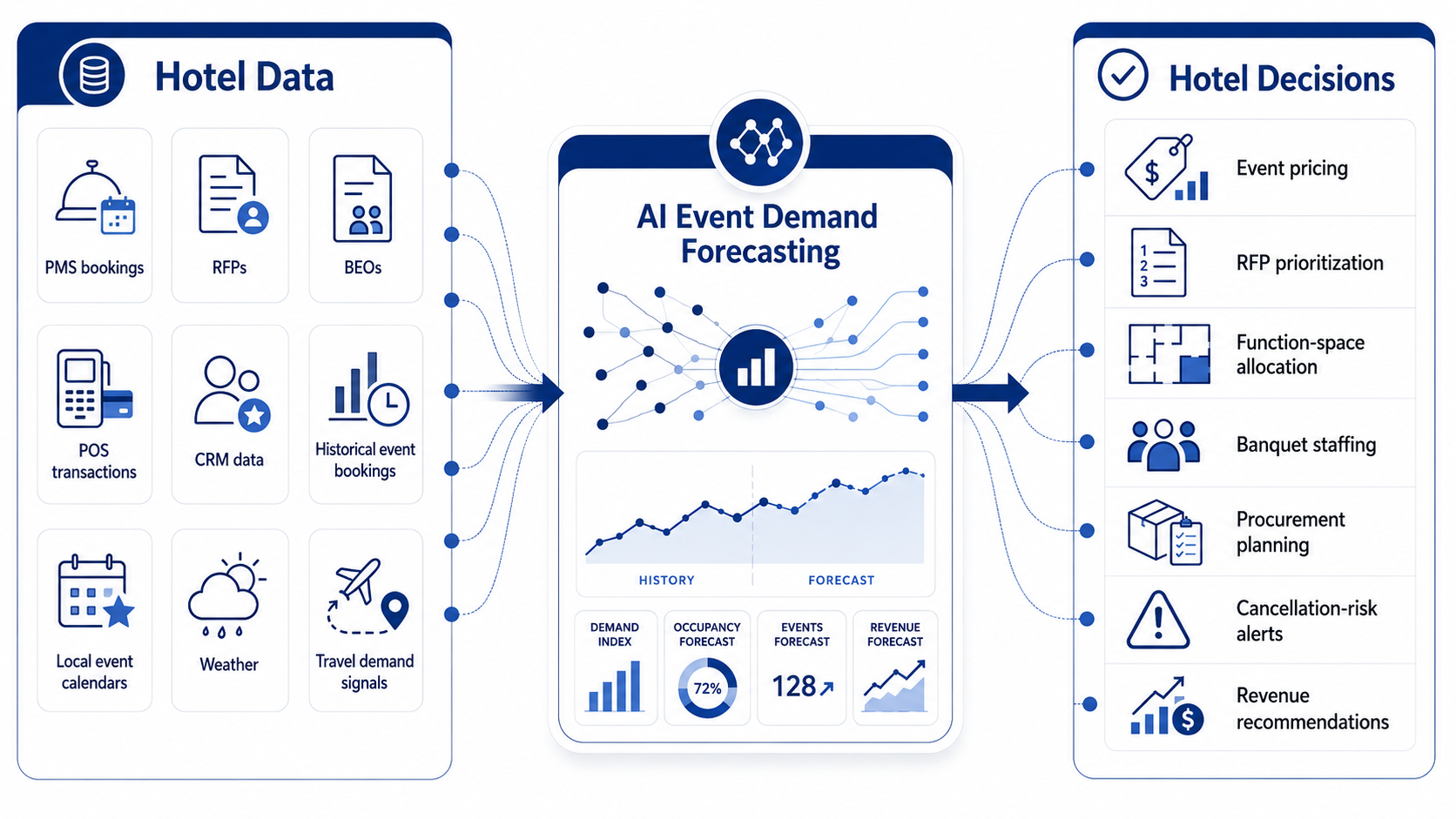
An Event Demand Forecasting AI Agent works by combining historical hotel data, current booking and sales signals, external demand indicators, and operational information. It transforms this data into forecasts and recommendations that can support event pricing, RFP prioritization, space allocation, staffing, and procurement decisions.
The process generally follows a continuous cycle of data collection, forecasting, recommendation, human review, and learning from actual event outcomes.
What data does the AI agent use?
The AI agent uses internal hotel data together with external demand signals to build event-demand forecasts and recommendations.
Internal hotel data may include:
- PMS data such as group blocks, pickup, occupancy, and room availability
- S&C records such as RFPs, proposals, Banquet Event Orders (BEOs), and function-space inventory
- RMS pricing and demand information
- POS data for event and F&B spending
- CRM account and customer history
- Labor schedules and staffing data
- Procurement and inventory records
- Website and digital engagement data
External signals may include:
- Convention and Visitors Bureau (CVB) calendars
- Cvent or other meetings-marketplace information
- Local conventions and citywide events
- Airline schedules
- Holidays and school calendars
- Weather
- Macroeconomic indicators
- Venue and event listings
- Online demand and search trends
The forecasting system can normalize these different data sources and connect related accounts, event segments, spaces, and booking records.
How does it prepare hospitality event data?
The system prepares hospitality event data by standardizing records and turning booking, customer, pricing, timing, and space information into forecasting features.
The system can create forecasting features from hotel and event information such as:
- Booking lead time
- Day of the week
- Seasonality
- Event duration
- Historical conversion rate
- Account-level booking behavior
- Previous attendee and spending patterns
- Function-space capacity and layout
- Setup and turnaround requirements
- Historical event pricing
- Minimum-spend thresholds
- Hotel occupancy and market compression
These features help the forecasting models identify patterns that may not be visible from booking totals alone.
Which forecasting models can it use?
AI event forecasting can use time-series, classification, regression, scenario-analysis, and hierarchical models depending on the forecasting objective.
Depending on the use case, AI event forecasting may use:
- Time-series models to forecast inquiries, bookings, pickup, and event demand
- Classification models to estimate RFP conversion or cancellation probability
- Regression models to estimate revenue per attendee, F&B spend, or ancillary revenue
- Scenario analysis to compare pricing, space, or policy alternatives
- Hierarchical models to forecast demand at space, property, market, or portfolio level
The appropriate modeling approach depends on the hotel's available data, forecasting horizon, and business objective. Research published in the International Journal of Hospitality Management also identifies accurate demand forecasting as a core component of hotel revenue-management decisions.
How far in advance can it forecast event demand?
AI event demand forecasting can support horizons from the next few days to 18 months, depending on the hotel decision being planned.
Different forecasting horizons support different decisions:
- 0–14 days: staffing, purchasing, final attendance adjustments, and event execution
- 2–12 weeks: event pricing, function-space optimization, and menu planning
- 3–6 months: sales pipeline planning, marketing activity, and demand development
- 6–18 months: budgeting, portfolio planning, sales goals, and longer-term resource decisions
Forecast confidence can also be updated as new information becomes available and the event date approaches.
How are recommendations delivered to hotel teams?
Recommendations can be delivered through dashboards, alerts, embedded workflows, APIs, or connected hotel systems.
Forecasts can be translated into recommendations such as:
- Suggested function-space pricing
- Minimum-spend recommendations
- RFP prioritization
- Function-space allocation
- Group displacement analysis
- Banquet staffing requirements
- Housekeeping and engineering resource planning
- Menu and procurement quantities
- Cancellation-risk alerts
- Sales and marketing opportunities
These recommendations can appear through dashboards, alerts, embedded workflows, or connected hotel systems.
How does human oversight work?
Hotel sales, revenue, and operations teams should remain involved in decisions.
Teams can accept, modify, or reject AI recommendations based on customer relationships, strategic accounts, service standards, contractual commitments, local knowledge, or circumstances that may not be fully represented in historical data.
Human overrides can also provide feedback that helps improve future recommendations.
Practical hotel event forecasting example
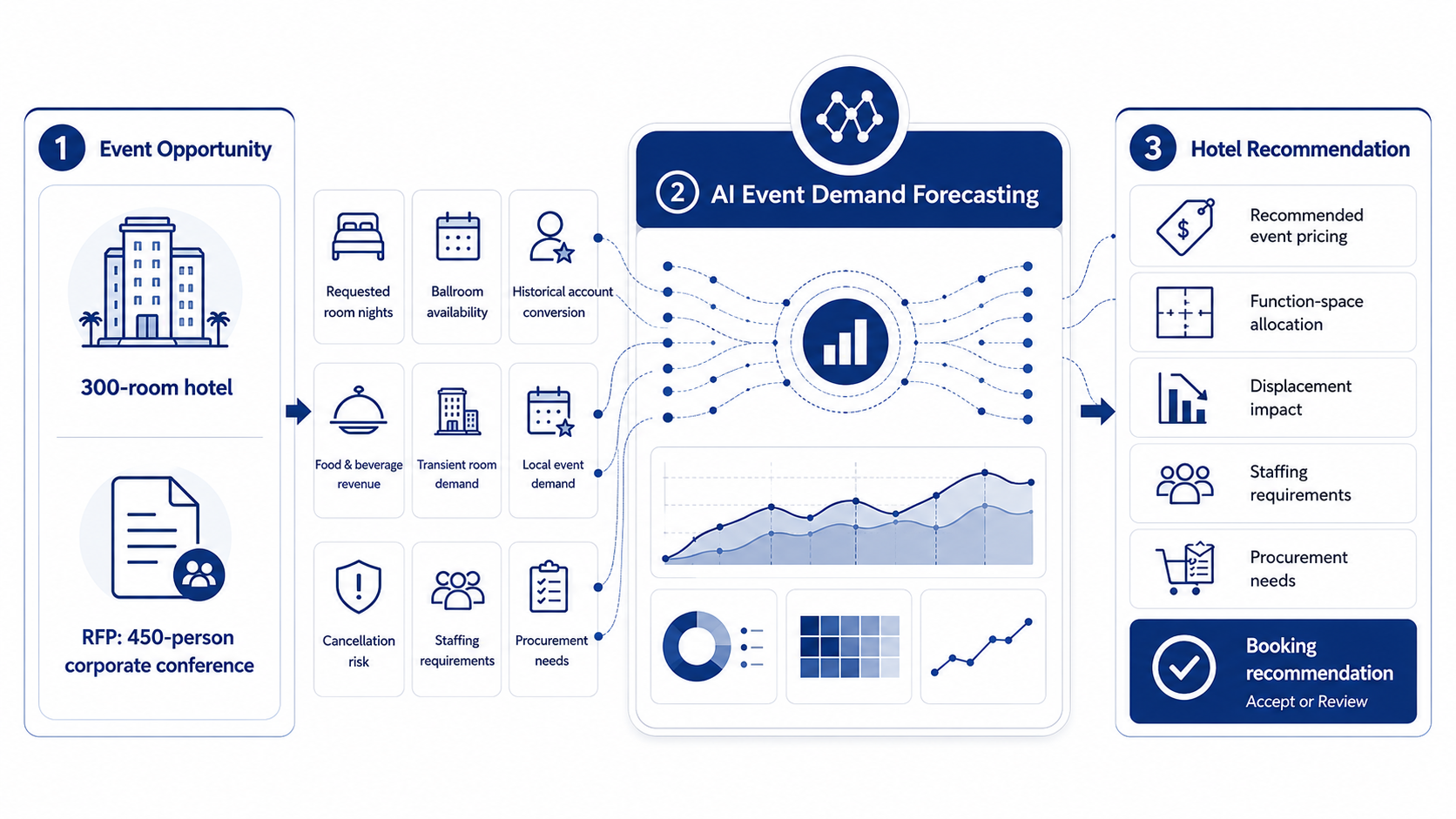
Consider a 300-room hotel that receives an RFP for a 450-person corporate conference. The forecasting system can compare historical account conversion, requested room nights, ballroom availability, expected F&B spend, transient room demand, local events, and cancellation risk.
Instead of reviewing each factor separately, revenue and sales teams can use the combined forecast to compare the total value of the event, identify potential displacement, review staffing and procurement requirements, and decide whether the proposed pricing and space allocation make business sense.
This example shows how AI event demand forecasting can connect revenue, sales, and operations decisions around the same event opportunity.
What are the benefits of AI Event Demand Forecasting in Hospitality?
AI Event Demand Forecasting helps hotels improve event pricing, staffing, procurement, RFP prioritization, and function-space utilization by giving teams earlier visibility into expected demand.
How can it improve event revenue?
AI event forecasting can improve revenue decisions by helping hotels price function space, compare group and transient demand, prioritize valuable RFPs, and identify ancillary revenue opportunities.
Hotel event forecasting can help teams:
- Adjust function-space pricing according to expected demand
- Set more informed minimum spends
- Compare event business with transient room opportunities
- Identify higher-value RFPs
- Surface ancillary revenue opportunities such as F&B, audiovisual packages, premium menus, parking, and extended stays, supported by Upsell Opportunity Intelligence where relevant
The goal is to evaluate the total value of an event rather than focusing on function-space revenue alone.
How can it improve staffing efficiency?
Forecasts can help hotel operations estimate staffing requirements by event type, attendance, time slot, and function.
This may help teams:
- Plan banquet staffing earlier
- Reduce unnecessary overstaffing
- Identify periods that may require additional labor
- Coordinate housekeeping, engineering, bartending, stewarding, and setup teams
- Prepare for simultaneous events and function-space turns
How can it reduce food waste and procurement issues?
Attendance and menu forecasts can help F&B and procurement teams estimate expected quantities more accurately. For broader F&B optimization, hotels can connect this workflow with Menu Profitability Optimization.
The system can support:
- Food and beverage order planning
- Vendor scheduling
- Menu-level demand forecasting
- Inventory allocation
- Adjustments after attendance changes
- Identification of potential spoilage or stockout risks
How can it help hotel sales teams?
AI event forecasting can help sales teams determine which opportunities require immediate attention.
It can support:
- RFP prioritization based on expected value and conversion likelihood
- Faster identification of high-potential opportunities
- More consistent pricing and terms
- Account-level rebooking analysis
- Better coordination between sales and revenue teams
How can it improve the guest and event planner experience?
Better demand visibility can help ensure that staffing, food, equipment, function-space setups, and other operational requirements are aligned with expected event activity.
This can help teams reduce last-minute operational changes, setup delays, shortages, and inconsistencies that may affect event planners or guests.
How can it support portfolio-level planning?
Hotel groups can use standardized event-demand metrics to compare properties, identify underused function space, detect market-level demand patterns, and coordinate sales strategies across a portfolio.
How does Event Demand Forecasting AI integrate with hotel systems?
AI event demand forecasting can integrate with hotel systems such as Property Management Systems, Sales and Catering platforms, Revenue Management Systems, CRM platforms, POS systems, procurement tools, and BI platforms.
Integrations may use APIs, data connectors, scheduled feeds, webhooks, and embedded analytics depending on the hotel's technology environment.
How does it integrate with PMS, S&C, and RMS platforms?
The forecasting system can exchange booking, pricing, space, and demand data with PMS, Sales and Catering, and Revenue Management platforms through available integrations.
The forecasting system can connect with:
- PMS platforms such as Oracle OPERA or Infor HMS for group blocks, pickup, room availability, and occupancy data
- S&C platforms such as Amadeus Delphi, OPERA Sales and Catering, or Tripleseat for RFPs, BEOs, function-space inventory, and event activity
- RMS platforms for room-demand forecasts, rate strategies, and displacement analysis
Bidirectional integration can help keep forecasts, pricing decisions, group blocks, and space availability aligned.
How does it use event marketplaces and external demand signals?
The AI agent uses external demand signals to identify market changes that may affect hotel event and room demand before they appear in confirmed bookings.
External sources may include:
- Cvent and other meetings marketplaces
- CVB calendars
- Citywide convention schedules
- Local sports and entertainment events
- Airline schedules
- Public holidays
- Website demand indicators
These signals can help the system identify demand changes that may not yet be visible in confirmed hotel bookings.
How does it connect with POS and procurement systems?
POS data helps measure event-related F&B and ancillary spending.
Procurement and inventory integrations can help teams translate attendance and menu forecasts into:
- Purchase quantities
- Vendor requirements
- Inventory planning
- Waste monitoring
- Event-specific preparation
Actual consumption can then be compared with forecasts to improve future planning.
How does it integrate with CRM and marketing platforms?
The forecasting system can use CRM and marketing data to understand account history, engagement, segment behavior, and rebooking potential.
CRM data can provide information about:
- Account history
- Previous bookings
- Customer engagement
- Segment behavior
- Sales activity
This information can help hotel sales teams identify accounts that may be more likely to rebook or respond to outreach during specific demand periods.
Security and IT governance
Depending on the deployment, hotels may also require:
- Single Sign-On (SSO)
- Security Assertion Markup Language (SAML)
- Role-based access
- Audit logs
- Encryption in transit and at rest
- Environment segregation
- Appropriate privacy and payment-data controls
Security requirements should reflect the type of hotel, guest, planner, account, and payment data being processed. Where cardholder data is stored, processed, or transmitted, hotels should also evaluate applicable PCI Data Security Standard (PCI DSS) requirements.
How should hotels measure the impact of AI Event Demand Forecasting?
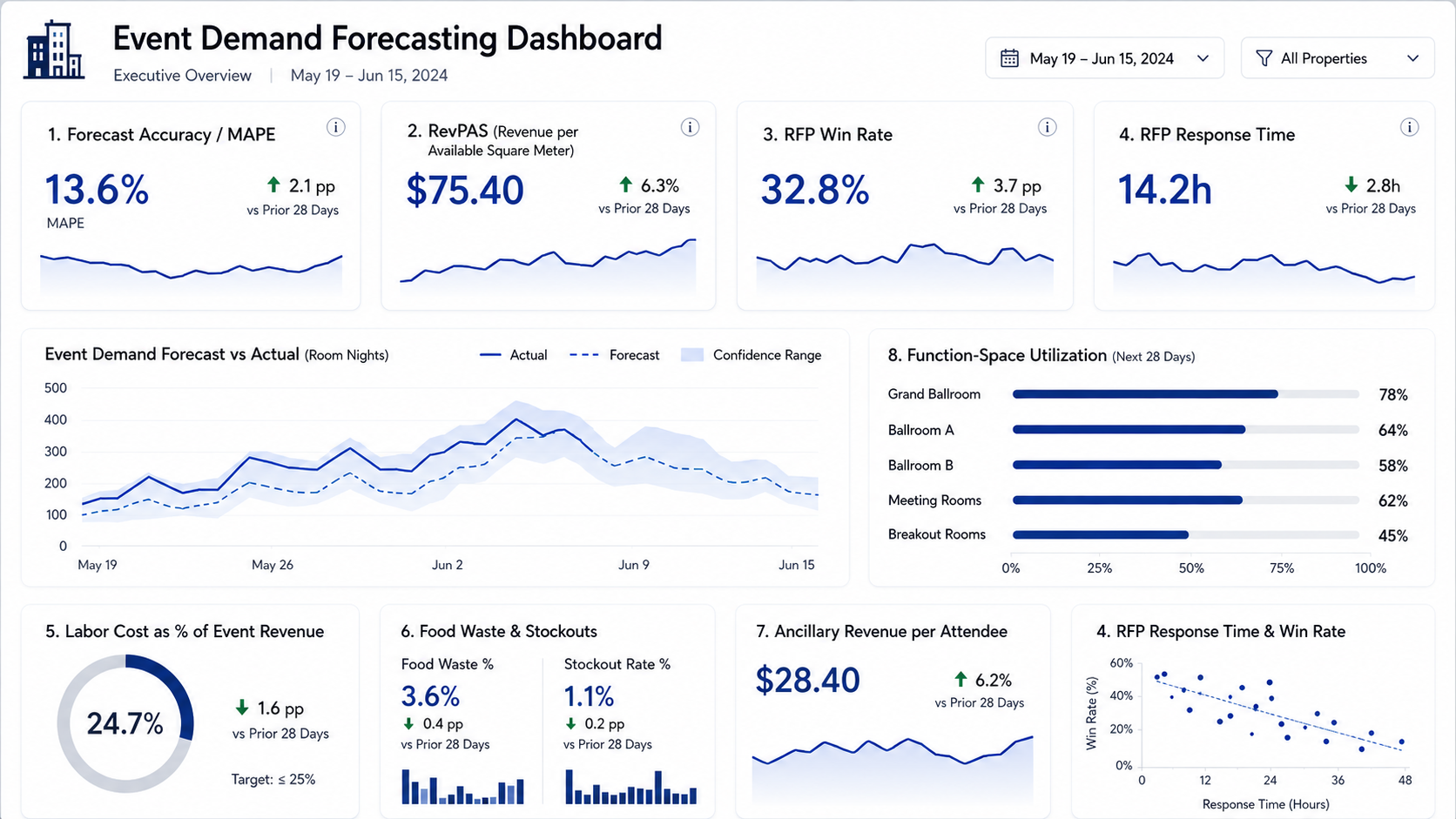
Hotels should measure the impact of AI Event Demand Forecasting by comparing forecast accuracy and business performance before and after implementation. The most useful Key Performance Indicators (KPIs) connect forecast quality with revenue, sales, staffing, procurement, and function-space utilization.
| Area | KPI to Track | What It Measures |
|---|---|---|
| Forecasting | Mean Absolute Percentage Error (MAPE) or forecast error | How closely predicted event demand matches actual demand |
| Function space | RevPAS or RevPASM | Revenue generated from available event space |
| Sales | RFP win rate | How effectively qualified event opportunities convert into bookings |
| Sales speed | RFP response time | How quickly sales teams respond to event planners |
| Labor | Labor cost as a percentage of event revenue | Whether staffing levels are aligned with actual event demand |
| Procurement | Food waste and stockout rate | How accurately purchasing and preparation match attendance |
| Ancillary revenue | Revenue per attendee | Revenue generated from F&B, AV, parking, spa, and other event services |
| Space utilization | Function-space utilization rate | How efficiently ballrooms, meeting rooms, and other event spaces are used |
Hotels should establish baseline performance before implementation and monitor these KPIs over time. This makes it easier to determine whether improvements come from better forecasting, operational changes, or other market factors.
What are the most common use cases for AI Event Demand Forecasting?
Common use cases include function-space pricing, RFP prioritization, group displacement analysis, staffing, procurement planning, cancellation forecasting, space allocation, and citywide demand forecasting.
Dynamic function-space pricing
Hotels can adjust meeting-room rates, packages, and F&B minimums based on expected demand, compression, event type, function-space availability, and historical price response.
Scenario analysis can help teams compare different pricing approaches before confirming an event.
RFP scoring and prioritization
AI can rank inbound RFPs based on factors such as:
- Expected event revenue
- Account history
- Conversion likelihood
- Function-space fit
- Room demand
- Ancillary revenue
- Displacement implications
Sales teams can then prioritize opportunities that are more closely aligned with hotel objectives.
Group displacement analysis
A group booking may consume rooms that could otherwise be sold to transient guests.
AI forecasting can help compare expected:
- Group room revenue
- Transient room revenue
- Function-space revenue
- F&B spend
- Ancillary revenue
- Operational costs
This gives revenue teams a broader view of the value of accepting or declining a group.
Banquet and housekeeping staff scheduling
Forecasts can estimate:
- Setup requirements
- Event attendance
- Room turns
- Banquet staffing
- Housekeeping workload
- Engineering support
- Bartending and stewarding requirements
This allows operations teams to prepare before the event instead of reacting only after final guarantees are submitted.
Menu planning and procurement
AI can use event schedules, attendance forecasts, historical consumption, and menu selections to estimate purchasing and preparation requirements.
Forecasts can also be updated when guest counts or event plans change.
Cancellation and attrition forecasting
Historical booking behavior, lead time, account history, event type, and other indicators can be used to estimate cancellation or attrition risk.
Hotels can use these insights when reviewing deposits, guarantees, cancellation terms, and inventory commitments.
Function-space allocation
AI forecasting can help hotels decide how to allocate ballrooms, meeting rooms, breakout rooms, and other spaces while accounting for capacity, setup requirements, timing, and expected demand.
It can also identify opportunities to combine or divide spaces depending on the event schedule.
Citywide event demand forecasting
Conventions, concerts, sports events, holidays, and other citywide activities can affect hotel event and room demand.
Bringing these signals into the forecast helps hotel teams prepare pricing, sales, staffing, and procurement decisions earlier.
Account-level demand planning
Historical account data can help identify:
- Customers likely to rebook
- Typical booking windows
- Preferred event periods
- Historical event value
- Previous conversion behavior
Sales teams can use these signals to determine when outreach may be most relevant.
Marketing activation during low-demand periods
Hotels can identify future periods where event demand is expected to be weaker and coordinate targeted campaigns toward relevant customer segments.
This can help sales and marketing teams focus demand-generation activity on periods where additional business is needed.
How does AI Event Demand Forecasting improve hotel decision-making?
AI Event Demand Forecasting improves hotel decision-making by turning demand signals into practical recommendations with clear explanations and trade-offs. Instead of relying only on historical averages or individual judgment, hotel teams can compare revenue opportunities, operational requirements, and potential risks before making a decision.
How does AI explain its recommendations?
The AI agent can show the factors influencing a recommendation, such as historical conversion rates, seasonality, citywide events, function-space availability, expected ancillary spend, and cancellation risk.
This helps teams understand why a particular event, price, or operational action is being recommended.
How does it help teams compare trade-offs?
AI helps hotel teams compare the revenue, cost, capacity, and displacement impact of competing event opportunities before making a decision.
Hotels often need to balance competing opportunities.
For example, accepting a large group may generate event and F&B revenue but could displace higher-rated transient room demand.
AI forecasting can help teams compare these scenarios by evaluating expected room revenue, event revenue, space utilization, operational costs, and demand conditions before a final decision is made.
How does it improve coordination across departments?
A shared event-demand forecast gives Sales, Revenue Management, Banquets, F&B, Housekeeping, Engineering, and Procurement a common view of expected demand.
This helps departments coordinate pricing, staffing, inventory, room setups, and other operational requirements around the same forecast rather than planning independently.
How can hotels maintain human control over AI recommendations?
AI recommendations should operate within hotel-defined rules and approval thresholds.
Teams can accept, modify, or reject recommendations based on factors such as pricing policies, service standards, contractual commitments, and local market knowledge.
Human oversight remains especially important for unusual events, strategic accounts, major group opportunities, and situations where historical data may not fully reflect current market conditions.
What are the risks and limitations of AI Event Demand Forecasting?
The main risks include poor data quality, integration challenges, privacy concerns, model drift, limited explainability, and low user adoption. Human oversight and clear governance help hotels manage these risks. The NIST AI Risk Management Framework provides a broader framework for managing trustworthiness and AI-related risks.
How does poor data quality affect forecasts?
Incomplete or inconsistent S&C records, missing BEO information, duplicate accounts, inaccurate event segments, or poorly maintained historical data can reduce forecast reliability.
Hotels may need:
- Data validation rules
- Standardized event classifications
- Duplicate detection
- Staff training
- Periodic data-quality reviews
Improving data quality should be part of implementation rather than treated as a separate issue.
What privacy and security risks should hotels consider?
Key risks include unauthorized access, exposure of personal or payment-related data, weak access controls, and inappropriate data retention.
Event and customer data may contain personally identifiable information, account information, booking details, or payment-related data.
Hotels should evaluate:
- Encryption
- Access control
- Authentication
- Audit logs
- Data retention
- Vendor security
- Applicable privacy requirements
- Payment-data requirements where relevant
How can hotels manage AI bias and explainability?
Hotels can manage AI bias and explainability through transparent reason codes, model monitoring, human review, and documented override processes.
Recommendations should not depend entirely on black-box outputs.
Hotel teams should be able to understand important factors behind predictions and review whether models are creating unintended patterns across accounts, customer segments, event types, or markets.
Reason codes, model monitoring, human review, and documented override processes can improve transparency.
What happens when market conditions suddenly change?
When market conditions change suddenly, forecasts may become less reliable and should be updated using new signals, scenario analysis, and human overrides.
Unusual events such as severe weather, strikes, travel disruption, economic shocks, or other major changes may cause historical patterns to become less reliable.
Forecasting systems should therefore support:
- Model-drift monitoring
- Rapid forecast updates
- Scenario planning
- Manual adjustments
- Human overrides
What integration challenges should hotels expect?
Hotels may face limited APIs, inconsistent data formats, delayed data feeds, and legacy-system constraints when connecting AI forecasting tools.
Legacy systems may not provide consistent APIs or real-time data.
Hotels may need to use:
- Scheduled data feeds
- Middleware
- Data warehouses
- API connectors
- Interim manual processes
A phased implementation can help reduce disruption while critical systems are connected.
Change management and adoption
A technically accurate forecast will have limited value if hotel teams do not incorporate it into daily decisions.
Sales, revenue, operations, and procurement teams may need training, clear ownership, and defined workflows around AI-generated recommendations.
Cost-benefit alignment
Implementation should be tied to measurable business objectives.
Hotels should compare software, integration, data-management, and change-management costs with the KPIs they are trying to improve before scaling across multiple properties.
What is the future of AI Event Demand Forecasting in Hospitality?
AI Event Demand Forecasting is moving toward real-time demand signals, greater automation, deeper hotel-system integration, total-revenue optimization, and sustainability-aware event planning.
Real-time demand signals
Forecasting systems may increasingly incorporate live or frequently updated signals such as:
- Website behavior
- RFP activity
- Flight schedules
- Local event changes
- Booking pace
- Function-space availability
- Payment and reservation activity
This can help hotels adjust near-term forecasts as conditions change.
Automated forecasting and recommendations
More recommendations may eventually be executed automatically within predefined hotel rules.
Examples could include:
- Pricing adjustments
- Staffing holds
- Procurement updates
- Space-allocation recommendations
- Sales alerts
Human approval can remain focused on strategic accounts, exceptions, unusual events, and higher-impact decisions.
Total hotel revenue optimization
AI forecasting can increasingly connect room revenue with:
- Meetings and events
- F&B
- Spa
- Parking
- Retail
- Other hotel outlets
This creates the potential for decisions based on the total expected value of a guest or event rather than optimizing each revenue stream independently.
Sustainability-aware event planning
Event forecasts can also support sustainability objectives by helping hotels align food purchasing, staffing, inventory, energy use, and other resources more closely with expected demand.
Frequently Asked Questions
How is an Event Demand Forecasting AI Agent different from a traditional Revenue Management System?
A Revenue Management System primarily focuses on room demand and rate optimization. AI event demand forecasting focuses more directly on meetings and events, including RFPs, function-space demand, group bookings, ancillary revenue, staffing, and event operations.
When connected, the two systems can help hotels evaluate both room demand and the total value of group and event business.
What data is needed for AI event demand forecasting?
Hotels typically need group booking, RFP, BEO, function-space, pricing, POS, pickup, cancellation, and local market data to begin event-demand forecasting.
Hotels can begin with data such as:
- PMS group bookings
- RFPs
- BEOs
- Function-space inventory
- Historical event pricing
- POS event spend
- Group pickup
- Cancellation and attrition history
- Local event calendars
Additional external signals may improve forecasting depending on the hotel's market and technology environment.
How often should event-demand forecasts be updated?
Event-demand forecasts should be refreshed as frequently as the decision requires and whenever meaningful new booking or market information becomes available.
Update frequency depends on the decision being supported.
Near-term staffing and procurement forecasts may need more frequent updates, while longer-term sales or budget forecasts may be refreshed less often.
Forecasts should also be recalculated when important new information becomes available, such as a major RFP, cancellation, citywide event announcement, or significant change in booking pace.
Will AI event forecasting replace hotel sales or event planning teams?
No. AI forecasting is better positioned as decision support for sales, revenue, event planning, and operations teams.
Human judgment remains important for relationships, negotiations, strategic accounts, creative event planning, service standards, exceptions, and on-site decisions.
Can AI event forecasting help reduce food waste in banquets?
It can help F&B and procurement teams estimate expected attendance, menu demand, and purchasing requirements more accurately.
Its effectiveness depends on the quality of event, attendance, menu, and consumption data available to the system.
How does it handle last-minute event changes or cancellations?
When updated booking or event information is available, the forecasting system can revise demand expectations and alert relevant teams.
Recommendations may include changes to staffing, procurement, function-space allocation, or sales activity to respond to the updated situation.
Which KPIs should hotels use to measure success?
Hotels should track forecast accuracy, RevPAS or RevPASM, RFP performance, function-space utilization, labor efficiency, food waste, and ancillary revenue.
Important KPIs may include:
- Forecast accuracy or MAPE
- RevPAS or RevPASM
- RFP win rate
- RFP response time
- Function-space utilization
- Labor cost as a percentage of event revenue
- Food waste
- Stockouts
- Ancillary revenue per attendee
- Event planner or guest satisfaction
Hotels should select KPIs based on the specific decisions the forecasting system is intended to improve.
Is AI event demand forecasting suitable for independent hotels?
Yes. Both independent hotels and larger hotel groups can use event-demand forecasting, although implementation requirements may differ.
Independent hotels may focus on a smaller number of high-value use cases, while larger brands may use forecasting across multiple properties for benchmarking, consistency, and portfolio planning.
Are you looking to build custom AI solutions and automate your business workflows?
Optimize Event Management in Hospitality with AI
Ready to transform Event Management operations? Connect with our AI experts to explore how Event Demand Forecasting AI Agent for Event Management in Hospitality can drive measurable results for your organization.
Our Offices

Ahmedabad
B-714, K P Epitome, near Dav International School, Makarba, Ahmedabad, Gujarat 380051
+91 99747 29554
Mumbai
C-20, G Block, WeWork, Enam Sambhav, Bandra-Kurla Complex, Mumbai, Maharashtra 400051
+91 99747 29554

Stockholm
Bäverbäcksgränd 10 12462 Bandhagen, Stockholm, Sweden.
+46 72789 9039

Malaysia
Level 23-1, Premier Suite One Mont Kiara, No 1, Jalan Kiara, Mont Kiara, 50480 Kuala Lumpur

Lewes
16192 Coastal Highway, Lewes, Delaware 19958, USA




